


TL;DR:
- Effective gallery improvements include conducting layout audits, applying the 30-degree lighting rule, and building visual cohesion. These steps enhance visitor engagement, increase dwell time, and boost sales by creating an appealing, organized space. Segmented marketing, real-time inventory management, and accessible design further optimize visitor experience and operational efficiency.
Art gallery improvement tips are practical actions that gallery owners and managers take to optimize space, increase visitor engagement, and improve sales performance. Galleries that maintain cohesive visual elements increase visitor dwell time by up to 40%. That single metric captures the entire argument: how your gallery looks, flows, and communicates directly affects how long visitors stay and how likely they are to buy. The tips below draw on professional installation standards, marketing funnel research, and operational best practices proven to work in 2026.
1. Art gallery improvement tips: start with a layout audit
Gallery layout is the foundation every other improvement builds on. Before you hang a single piece, walk every route a visitor will take and map it on paper. Effective exhibition design starts with a thorough needs analysis before any concept development, and that analysis begins with the physical space.
A layout audit covers three things:
- Visitor pathways: Trace the natural line of sight from the entrance and identify where visitors stop, turn, or backtrack.
- Zoning: Group works by theme, medium, or narrative so each zone feels intentional, not random.
- Modular flexibility: Plan for movable walls or partitions so you can reconfigure the space between exhibitions without major cost.
Pro Tip: Conduct a pathway audit before artwork delivery. Physically measure every door, corridor, and stairwell. A piece that cannot fit through the service entrance on installation day creates a crisis that no amount of planning recovers from quickly.
Clear zoning also guides purchasing decisions. When visitors move through a gallery with a logical narrative, they spend more time with individual works. More time with a work correlates directly with a higher likelihood of purchase.
2. Apply the 30-degree lighting rule to every installation
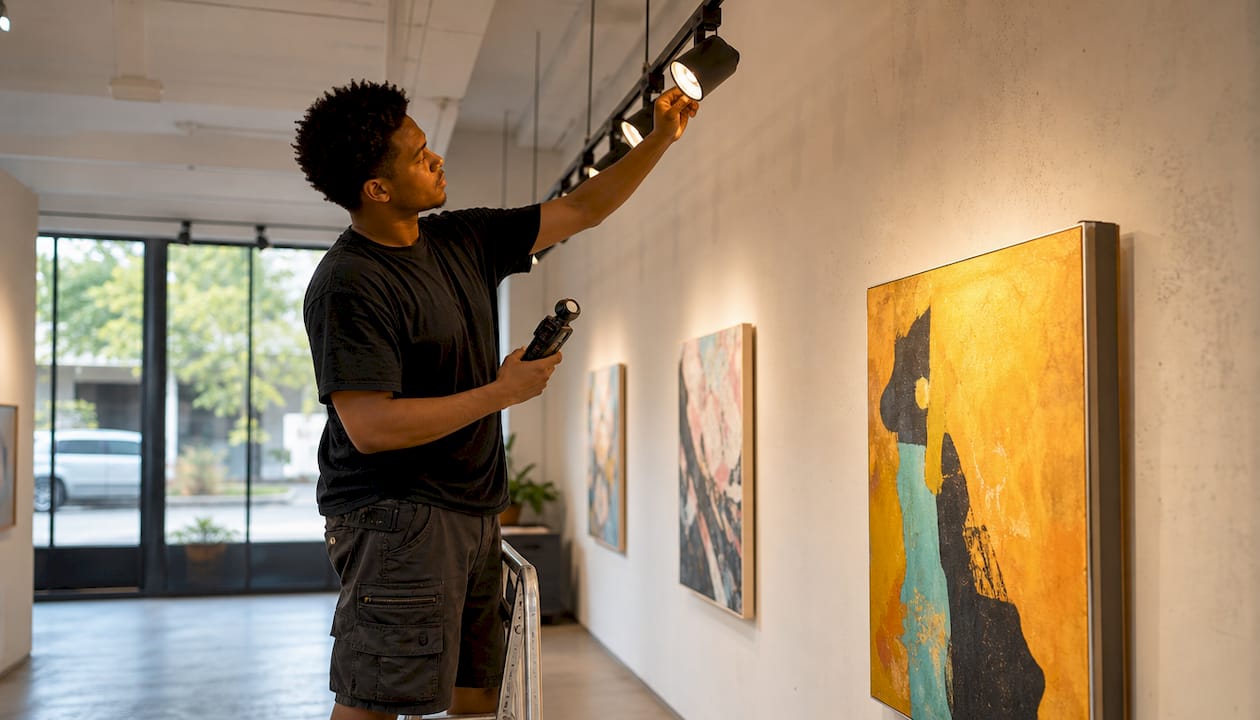
Lighting is the single most controllable variable in how art looks to a visitor. The 30-degree lighting rule is the professional standard: aim fixtures at a 30-degree angle from vertical to minimize glare while enhancing surface texture and color depth. That angle works across oil paintings, photography, and mixed media.
Key lighting principles to apply:
- Avoid natural sunlight on works. UV exposure fades pigments and degrades paper. Use UV-filtering glass or film on any skylight or window near artwork.
- Use adjustable intensity fixtures. A matte charcoal drawing needs lower lumens than a high-gloss acrylic. Dimmable LED track lighting gives you that control without heat damage.
- Balance ambient and accent light. Ambient light sets the mood of the room. Accent light draws the eye to specific pieces. Running both at the right ratio prevents the “cave with spotlights” effect that makes galleries feel cold.
Pro Tip: Test your lighting at the same time of day your gallery opens. Natural light through windows shifts the color temperature of the room, and what looks balanced at noon can look orange or flat by 3:00 PM.
3. Build visual cohesion across every touchpoint
Visual cohesion is not about making everything match. It is about making everything feel intentional. Galleries with consistent fonts, color palettes, and framing styles read as professional. Visitors trust professional spaces more and stay longer.
The 40% dwell time increase linked to cohesive visual elements is not accidental. When a visitor does not have to work to understand the space, they relax into it. Relaxed visitors look longer, ask more questions, and buy more often.
Apply cohesion across these areas:
| Element | What to standardize |
|---|---|
| Typography | One serif and one sans-serif font across all signage and labels |
| Color palette | Two to three wall colors that complement the works on display |
| Framing | Consistent frame profiles per exhibition, not per artist |
| Signage | Uniform label size, placement height, and information hierarchy |
Narrative flow matters as much as visual consistency. Each room should tell part of a larger story. Visitors who sense a narrative thread move through the gallery with purpose, and purposeful movement keeps them engaged through the final room rather than turning back halfway.
For inspiration on how art presentation shapes visitor interest, the principles apply equally to commercial galleries and private collections.
4. Structure your marketing around a four-stage funnel
One-size-fits-all marketing does not work for galleries. Collectors, casual visitors, and corporate buyers need different messages at different moments. A four-stage funnel, moving from awareness to interest to consideration to sale, gives you a framework to deliver the right message at each stage.
Here is how to build it:
- Awareness: Use targeted social media ads and local press to reach people who do not yet know your gallery exists.
- Interest: Publish exhibition previews, artist interviews, and behind-the-scenes content to build curiosity.
- Consideration: Send personalized email campaigns to your contact list. Segmented mailing lists organized by collector interest outperform generic blasts by a significant margin. A collector who buys abstract works should never receive a pitch for representational portraits.
- Sale: Remove friction at the point of purchase. Flexible payment options like installment plans can increase gallery sales by as much as 41%. That is not a minor lift. It is the difference between a visitor who admires and a visitor who buys.
For social media specifically, two-phase campaigns work best: run awareness ads one to two weeks before an opening, then switch to conversion-focused content during the first week after opening. That timing matches how collectors actually make decisions.
5. Manage inventory like a database, not a spreadsheet
Effective inventory management means documenting provenance, condition, current status, and location for every work in your collection. A comprehensive art asset database lets you respond to collector inquiries in real time without scrambling through paper files or outdated spreadsheets.
Practical steps to get this right:
- Assign each work a unique identifier tied to its acquisition record.
- Log condition reports with photographs at intake and after every loan or exhibition.
- Track status fields: available, on loan, sold, reserved, or in restoration.
- Record location at all times, including which wall, which storage rack, or which shipping crate.
Pro Tip: Review your inventory records before every exhibition install. Works listed as “available” that are actually out on loan create embarrassing gaps in a show. A 15-minute database check before the planning meeting saves hours of rescheduling later.
Good inventory practice also protects you legally. Provenance documentation is the first thing a serious collector or estate attorney requests. Galleries that cannot produce it lose sales and credibility simultaneously.
6. Make accessibility a design requirement, not an afterthought
Accessible galleries attract more visitors and retain them longer. Ramps, wide pathways, and seating areas are baseline requirements. Beyond the physical basics, consider sensory accommodations: large-print labels, audio descriptions, and tactile elements for visitors with visual impairments.
Alternate label formats serve a broader audience than you might expect. A visitor who reads slowly, processes language differently, or simply prefers a shorter description benefits from a plain-language label alongside the standard curatorial text. Two label formats per work adds minimal cost and measurably expands your audience.
Data analytics and visitor feedback close the loop. Install a simple feedback station near the exit, or send a short post-visit survey by email. Track which rooms visitors spend the most time in, which works generate the most inquiries, and which labels prompt questions. Use that data to adjust your next exhibition before it opens, not after.
7. Use collaborative programming to deepen visitor engagement
Collaborative exhibitions involving artists, academics, and community members avoid echo chambers and deliver more relevant visitor experiences. A show curated entirely by one person reflects one perspective. A show built with input from the artists, a local historian, and a community group reflects a conversation. Visitors feel that difference immediately.
Interactive installations extend the effect. A work that visitors can respond to, whether through a written response wall, a digital touchscreen, or a participatory element, creates a memory that a static show cannot. Galleries like Kunsthaus Bregenz have demonstrated how spatial and programmatic choices together create experiences visitors return to and recommend.
Programming also drives repeat visits. An opening reception, an artist talk, a workshop, and a closing event turn a single exhibition into four separate reasons to visit. Each event reaches a slightly different segment of your audience and builds the kind of community that sustains a gallery long-term.
8. Invest in digital display and printing quality
The physical quality of printed works sets the floor for how visitors perceive your gallery. A print with banding, color shift, or visible pixelation signals low standards to every collector in the room. Gallery-quality digital printing uses archival inks and fine-art substrates that hold color accurately for decades.
Digital printing also opens new programming possibilities. You can exhibit works by artists who cannot ship originals, create limited-edition prints as a secondary revenue stream, or produce large-format reproductions for educational displays. The impact of digital printing on gallery programming has expanded significantly as print quality has caught up with collector expectations.
For galleries considering innovative display approaches in 2026, digital printing paired with strong curation creates a flexible, cost-effective way to keep exhibitions fresh without the logistics of shipping originals.
Key takeaways
The most effective gallery improvements combine spatial design, professional lighting, cohesive branding, targeted marketing, and rigorous operations to increase both visitor engagement and sales.
| Point | Details |
|---|---|
| Layout audit first | Measure every access point and map visitor pathways before installation begins. |
| 30-degree lighting standard | Aim fixtures at 30 degrees from vertical to reduce glare and reveal texture. |
| Visual cohesion drives dwell time | Consistent fonts, framing, and signage increase visitor dwell time by up to 40%. |
| Segment your marketing | Organize contact lists by collector interest and use two-phase social media campaigns. |
| Inventory as a database | Document provenance, condition, status, and location for every work in real time. |
What I have learned from watching galleries get this wrong
The galleries that struggle most are not the ones with bad art. They are the ones that treat operations and marketing as secondary to curation. A beautifully curated show in a poorly lit, hard-to-navigate space with no follow-up marketing is a missed opportunity at every level.
The shift I see working in 2026 is galleries treating the visitor experience as a designed product, not a byproduct of hanging good work. That means auditing the space before every show, not just once at launch. It means building a marketing calendar that starts six weeks before an opening, not the week of. It means knowing where every work is and what its status is at any moment.
Collaborative programming is the piece most galleries underinvest in. Bringing in artists, community voices, and outside perspectives does not dilute curatorial authority. It builds the kind of trust with your audience that turns casual visitors into loyal collectors. The galleries doing this well are the ones growing their collector base while others are watching foot traffic flatten.
The technical details matter too. Lighting at the wrong angle, labels at the wrong height, a payment process with too many steps. Each one is a small friction point. Stacked together, they cost you sales you never knew you lost.
— Artify
How Artify supports your gallery’s next step
Running a gallery means making hundreds of decisions about what to show, how to present it, and how to reach the right buyers. Artify gives gallery owners and managers access to curated art collections built for quality and variety, so you can expand your exhibition offerings without the logistics of sourcing originals from scratch.
Artify also connects galleries with independent artists through its artist platform, making it straightforward to bring new voices into your programming. Whether you are building a themed exhibition or filling a gap in your current collection, Artify’s tools are built around the same principles this article covers: quality presentation, clear curation, and meaningful visitor connection. Visit Artify’s gallery to see what is available for your next show.
FAQ
What are the most effective art gallery improvement tips?
The most effective improvements focus on layout audits, professional lighting at the 30-degree standard, visual cohesion, segmented marketing, and real-time inventory management. Each area directly affects visitor engagement and sales performance.
How can I attract more visitors to my art gallery?
Use a two-phase social media campaign, one to two weeks before opening and through the first week after, combined with segmented email outreach to collectors by interest. Collaborative programming and community events also drive repeat visits.
How does lighting affect art gallery visitor experience?
Lighting aimed at 30 degrees from vertical minimizes glare and enhances texture, making works more visually compelling. Poor lighting flattens color and reduces the time visitors spend with individual pieces.
What is the best way to manage art gallery inventory?
Treat inventory as a database, not a list. Document provenance, condition, status, and location for every work, and update records before each exhibition install to avoid gaps or misplaced pieces.
How do flexible payment options affect gallery sales?
Installment payment options can increase gallery sales by as much as 41% by removing the financial barrier for collectors who want a work but cannot pay the full price at once.