


TL;DR:
- Museum-grade giclée prints, acrylic face-mounts, stretched canvas, and full-service platforms like Artify offer different ways to turn personal photos into gallery-quality wall art. Generally, most consumers get the best results from a full-service platform that manages file prep, framing, and shipping.
Museum-grade giclée prints, acrylic face-mounts, stretched museum-grade canvas, and full-service custom platforms like Artify are the four realistic routes to turning a personal photo into collectible wall art. Each delivers genuine gallery results, but they suit different buyers.
- Museum-grade giclée print: Best for collectors who want archival longevity and the look of a fine-art edition. Pair with a Certificate of Authenticity for maximum provenance.
- Acrylic face-mount: Best for modern interiors where high-gloss optical clarity and depth matter more than texture.
- Stretched museum-grade canvas: Best for a traditional, textured, painterly feel without framing.
- Full-service custom platform (Artify): Easiest end-to-end experience, from upload to 3D room preview to framed delivery, with museum-grade options built in.
If you want one answer: most consumers get the best result from a full-service platform that handles file prep, proofing, framing, and shipping in one place.
Table of Contents
- What are your real gallery quality art options?
- What materials actually make a print gallery-grade?
- How do framing and finishing change the perceived quality?
- How do you prepare your photo files for gallery printing?
- How do you choose the right print size and preview it in your space?
- What do gallery-quality prints typically cost, and how long do they take?
- How do you vet a provider before you order?
- Pre-checkout checklist: confirm these before you order
- Key Takeaways
- Why most consumers are better served by a full-service platform
- Artify brings museum-grade printing and full-service convenience together
- Useful sources and further reading
- FAQ
What are your real gallery quality art options?
The table below maps each approach to the decision dimensions that actually matter at checkout.
| Approach | Output quality / longevity | Materials & framing | Customization | Preview tools | Price range | Turnaround | Return policy |
|---|---|---|---|---|---|---|---|
| Museum-grade giclée (print lab) | Archival, 100+ years | Fine-art rag or lustre paper, custom frame | High | Soft-proof only | — | 5–14 days | Varies by lab |
| Acrylic face-mount | Excellent clarity, UV-resistant | Museum acrylic, flush or float mount | Medium | Limited | — | 7–14 days | Varies |
| Stretched museum canvas | Archival inks on cotton/poly canvas | Stretcher bars, optional float frame | Medium-high | Limited | — | 5–10 days | Varies |
| Metal print | Durable, vivid, no glass needed | Aluminum substrate, standoff or flush | Low-medium | Limited | — | 5–10 days | Varies |
| Full-service platform (Artify) | Museum-grade giclée available | Multiple substrates, personalized framing | High | 3D room preview | Transparent, tiered | 5–14 days | Clear policy |
When to pick each:
- Choose a specialist print lab when you need a very large commission (60"+ wide) or want to work directly with a master printer on color calibration.
- Choose an acrylic face-mount for a photo with strong graphic contrast, a cityscape, or a portrait where you want the image to appear to float off the wall.
- Choose stretched canvas when the room calls for a warm, painterly texture and you prefer no glass.
- Choose a full-service platform when you want the whole process handled, from sizing to framing, without coordinating multiple vendors. Artify’s museum-grade gallery options include pre-made collections and custom orders side by side.
What materials actually make a print gallery-grade?
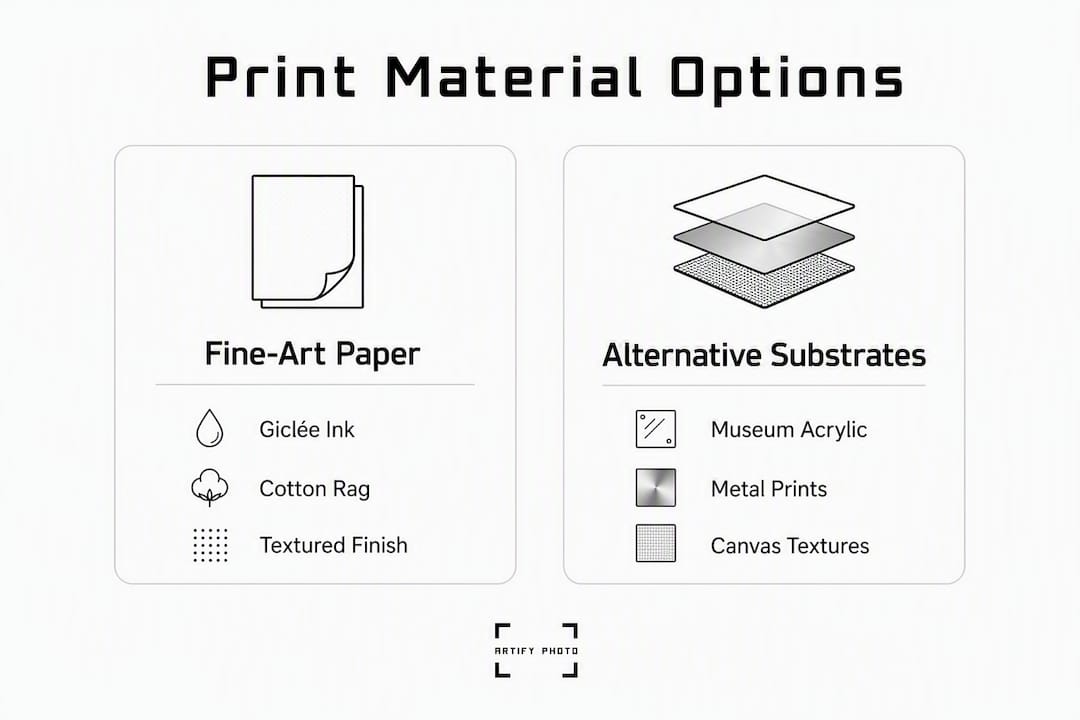
The gap between a drugstore print and a gallery print comes down to three things: the inkset, the substrate, and the process.
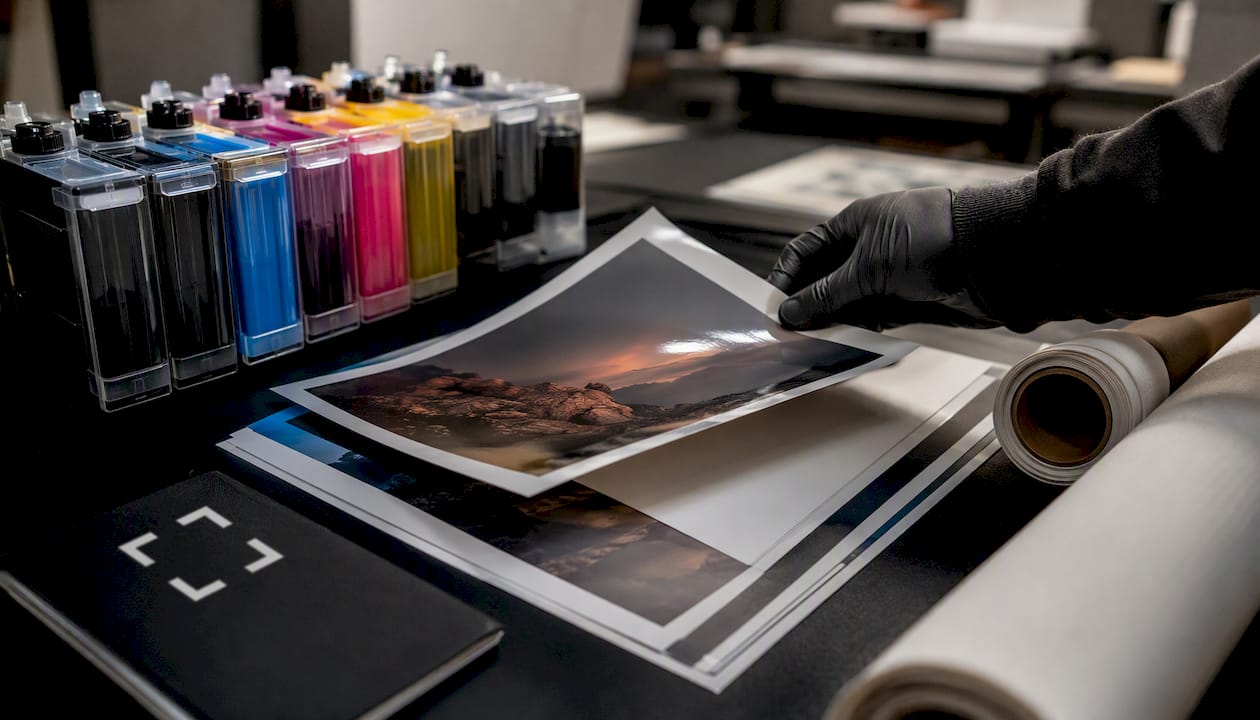
Giclée and archival inks are the foundation. Giclée (from the French verb gicler, to spray) describes fine-art inkjet printing using archival inksets that prioritize color fidelity and long-term stability over cheap pigment loads. Archival-grade pigment inks are rated for long-term stability under standard display conditions, which is what separates them from consumer photo prints that fade within a decade.
Paper and canvas choices shape the final look as much as the ink. Fine-art papers from Canson and Hahnemühle are the benchmark names to ask for. Match the finish to your subject: semi-gloss or lustre for architectural shots and high-detail images; matte, textured rag for portraits and organic subjects where softer tonality reads better.
Acrylic and metal substrates serve different visual goals. Museum-grade acrylic like Optium is optically clearer and more UV-protective than standard consumer acrylic or glass. A face-mount behind Optium gives a photo a luminous, almost backlit quality. Metal prints skip glass entirely and deliver vivid, moisture-resistant output, which makes them practical for kitchens or bathrooms.
How do framing and finishing change the perceived quality?
A great print’s perceived quality depends heavily on the framing and finishing, which can enhance or detract from its gallery presentation.
Common framing approaches:
- Float frame for canvas: The canvas sits inside the frame with a visible gap, creating depth. Works well for stretched canvas pieces.
- Traditional frame with museum mat for paper: A wide mat (typically 3"–4") draws the eye inward and signals fine-art presentation.
- Floater frame for thin panels: Acrylic or metal panels often use a slim floater that lets the substrate appear to hover.
Mounting options include stretcher bars for canvas, flush mount for a clean modern look, and face-mount acrylic for maximum depth and gloss. Each changes how light interacts with the surface.
Protective coatings matter for canvas especially. A UV-resistant varnish protects against fading and gives you control over the final sheen (matte, satin, or gloss). Anti-glare coatings on acrylic reduce reflections in bright rooms.
Pro Tip: Match the frame style to the photo’s mood. A heavily ornate gold frame on a minimalist black-and-white cityscape fights the image. Simple, thin profiles in natural wood or matte black let the photo lead.
How do you prepare your photo files for gallery printing?
File quality is the single most common reason a print disappoints. Fix this before you upload.
Resolution and pixel math:
- Target around 300 PPI at the final print size for sharp detail.
- Calculate required pixels by multiplying the print width (inches) by an appropriate PPI value.
- For very large prints, a lower PPI may be acceptable at normal viewing distance.
- Avoid upscaling low-resolution files to maintain detail. Always check pixel dimensions before ordering.
Color profile and soft-proofing:
- Shoot and edit in Adobe RGB for the widest gamut; convert to sRGB only if the provider requires it.
- Request a soft proof or ICC profile from your provider to simulate how the print will look on their specific paper and inkset.
- Calibrate your monitor with a hardware colorimeter (X-Rite ColorMunki or Datacolor Spyder) before making color decisions.
Cropping and aspect ratio:
- Confirm the print’s aspect ratio before cropping. A 16"×20" print has a different ratio than a 16"×24".
- Add bleed (typically 1/8"–1/4") if the image wraps around canvas edges.
Retouching basics:
- Reduce noise in shadow areas; noise prints larger than it looks on screen.
- Apply output sharpening for print (different from capture sharpening).
- Remove sensor dust spots. They are invisible on a phone screen and obvious at 24 inches.
How do you choose the right print size and preview it in your space?
Sizing mistakes are the most expensive kind because you usually can’t return a custom print.
- Measure the wall space. For a single focal piece, aim for a size that fills a substantial portion of the wall’s width.
- Use the viewing-distance rule: a comfortable viewing distance is roughly 1.5× the diagonal of the print.
- Standard gallery sizes fit standard frames and mats, which helps keep framing costs manageable.
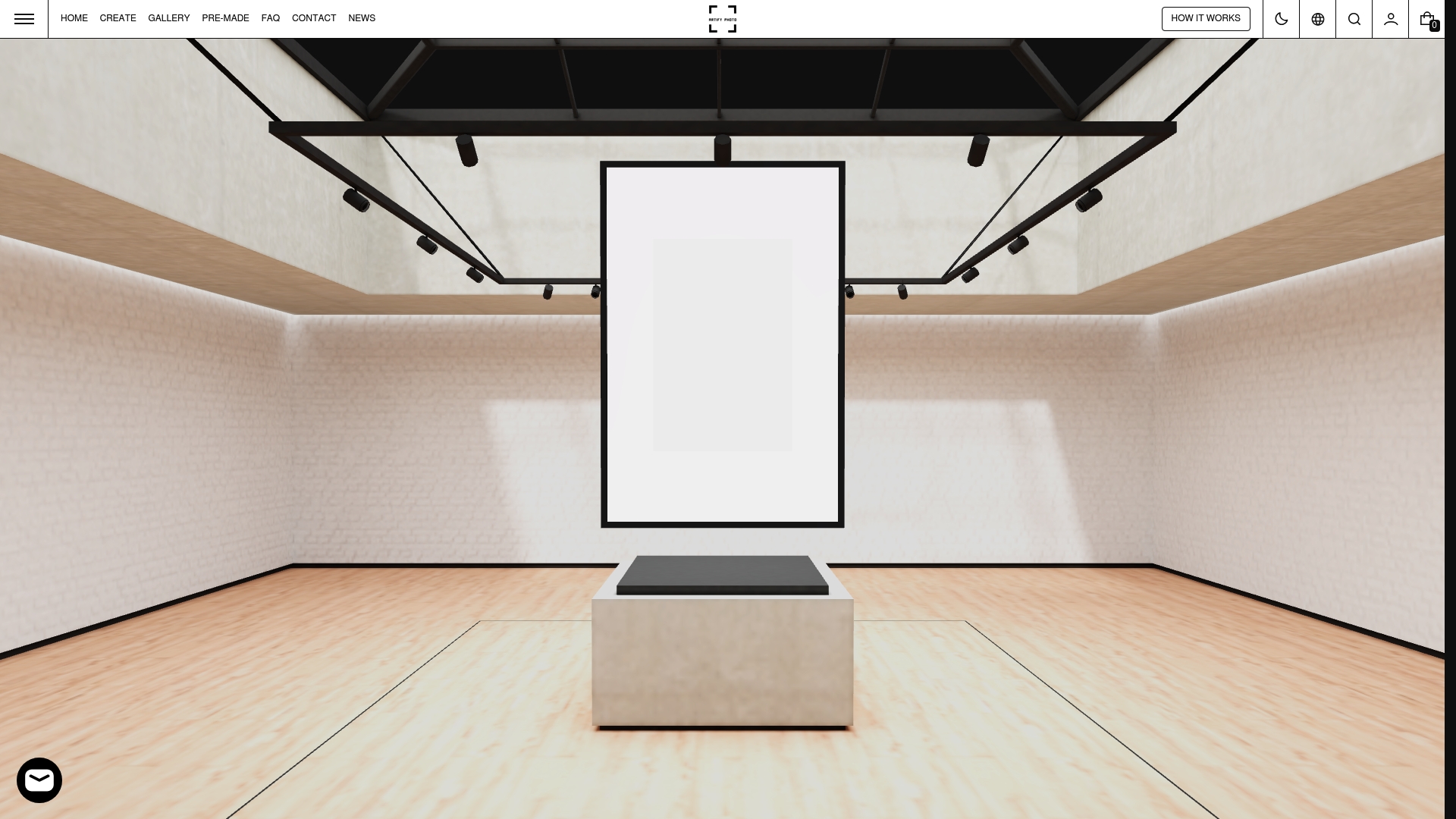
- Use a 3D room preview tool before committing. Artify’s 3D room preview lets you see the piece scaled to your actual wall before checkout, which removes most of the guesswork.
- For grouped displays, tape paper cutouts to the wall at scale before ordering. It takes ten minutes and saves hundreds of dollars.
Pro Tip: Order a small sample swatch or a 5"×7" proof print before placing a large order. Color and texture always look different in person than on a calibrated screen, and a $15 proof can save you from a $400 mistake.
For room-specific sizing guidance, Artify’s room-by-room wall art guide covers standard dimensions by space.
What do gallery-quality prints typically cost, and how long do they take?
Price varies significantly depending on substrate, size, and finishing level.
Typical turnaround times run about one to two weeks for production, plus shipping. Custom framing, signed COAs, and oversize pieces can extend production time. Additional costs for special shipping options and installation services may apply and are usually quoted separately.
How do you vet a provider before you order?
Generic phrases like “museum quality” mean nothing without specifics. Ask these questions before you commit.
- What inkset do you use? Ask for the manufacturer and pigment type. Archival pigment inks are the standard; dye-based inks are not.
- What paper or substrate manufacturer do you use? Canson, Hahnemühle, and Breathing Color are names that signal real fine-art production.
- Do you offer a soft proof or sample swatch? Professional printers inspect each piece before shipping; a provider that won’t send a proof is a red flag.
- Do you provide a Certificate of Authenticity? For limited editions and commissioned works, a signed COA verifies provenance and adds collectibility. It should include the edition number, print dimensions, substrate, and artist signature.
- What is your return policy? A clear, written return or reprint policy for defective or color-mismatched orders is non-negotiable.
Check third-party reviews and look for customer photos showing actual framed pieces, not just product renders. Provider transparency through detailed product pages and production descriptions is itself a trust signal.
Pre-checkout checklist: confirm these before you order
- File resolution confirmed at 300 PPI (or minimum acceptable PPI) at the final print size.
- Color profile set to the provider’s requirement (sRGB or Adobe RGB).
- Final crop reviewed at the correct aspect ratio, with bleed added if needed.
- Substrate and finish selected (paper type, canvas, acrylic, or metal).
- Framing option confirmed (float frame, mat, flush mount, or unframed).
- Soft proof or sample swatch requested if this is your first order with this provider.
- Shipping method selected (standard, white-glove, or crated for oversize).
- COA or artist attribution confirmed if you want a signed or numbered edition.
- Return/reprint policy reviewed and understood before payment.
Key Takeaways
Archival inksets, fine-art substrates, and a matched finishing method are the three non-negotiable elements that separate a gallery-quality print from a consumer photo product.
| Point | Details |
|---|---|
| Match material to intent | Giclée on fine-art paper for collectors; acrylic face-mount for modern gloss; canvas for textured warmth. |
| File prep determines print quality | Submit 300 PPI files in the correct color profile and confirm crop before uploading. |
| Always request a proof | A sample swatch or soft proof catches color and texture mismatches before a large order ships. |
| COA adds real value | A signed Certificate of Authenticity verifies provenance and matters for limited editions and resale. |
| Artify covers the full process | Upload, 3D preview, museum-grade print, personalized framing, and shipping in one platform. |
Why most consumers are better served by a full-service platform
The specialist print lab route is genuinely excellent, and for a very large commission or a collector-grade limited edition, working directly with a master printer makes sense. But for most people turning a personal photo into wall art, coordinating a separate lab, framer, and shipper adds friction without adding quality. A full-service platform that handles proofing, framing, and delivery in one place removes the gaps where mistakes happen. Artify’s 3D room preview and museum-grade print options mean you can see the piece at scale on your actual wall before you commit, which is a meaningful advantage over ordering blind from a lab. The cases where a specialist lab wins are real, but they are the exception, not the rule.
Artify brings museum-grade printing and full-service convenience together
Your photo deserves more than a consumer print. Artify delivers museum-grade giclée printing, personalized framing, and 3D room previews in a single platform, so you can go from upload to framed, shipped art without managing multiple vendors.
- Archival inksets and fine-art substrates rated for 100+ year longevity
- 3D room preview so you see the piece at scale before you order
- Personalized framing matched to your photo and interior
- COA support for limited editions and artist-attributed prints
- Pre-made collections for buyers who want ready-to-hang pieces with predictable materials
Start with the how it works page to see the full process, or browse pre-made collections if you want a curated piece ready to ship.
Useful sources and further reading
- Andrew Prokos on gallery production elements: Essential Elements of Gallery-Quality Fine Art Photography — detailed breakdown of archival inks, paper choices, and museum acrylic.
- Ashvin Harrison product page (COA example): The Divine Trinity Tree (2026) — a real-world example of a signed COA with edition details on a large-format fine-art piece.
- Artify’s museum-grade guide: Premium Wall Art Selection — covers materials and production techniques in depth.
- Artify’s art selection guide: How to Choose Art for Galleries — useful if you are still deciding between a custom photo print and a pre-made piece.
Always check your provider’s product pages for specific ink manufacturer names, paper specs, and proofing policies before ordering. Generic claims are easy to make; specific material names are what you want to see.
FAQ
What does “gallery quality” actually mean for a photo print?
It means the print uses archival pigment inks, acid-free fine-art paper or canvas, and a production process that preserves color fidelity for 100+ years under standard display conditions, distinguishing it from consumer photo prints.
What resolution do I need for a large gallery print?
Target 300 PPI at the final print size. Use appropriate pixel dimensions based on your print size to ensure sharp detail.
Do I need a Certificate of Authenticity for a custom photo print?
A COA is optional for personal decor but adds provenance and collectibility value for limited editions or commissioned works. A signed COA should include edition number, dimensions, substrate, and artist attribution.
How does Artify handle the proofing and preview process?
Artify offers a 3D room preview tool that lets you see your photo scaled to your wall before checkout, and the platform supports museum-grade print and framing options throughout the ordering process.
What is the difference between giclée and a standard photo print?
Giclée uses archival pigment inksets on fine-art substrates and is rated for 100+ year longevity. Standard photo prints use dye-based inks on consumer paper and typically fade within a decade under normal display conditions.