TL;DR:
- Proper artwork preservation depends on controlling light, humidity, physical contact, and using archival framing materials. Correct handling, regular inspection, and stable environmental conditions ensure artwork can outlast its owner and avoid irreversible damage.
Preserving artwork comes down to four controllable factors: light, humidity, physical contact, and the materials you use to store or frame it. Get those four right, and a painting or print can outlast its owner by centuries. Get them wrong, and damage is often permanent within years. The core rules are straightforward: use archival, pH-neutral materials; keep the environment cool, dry, and stable; never let artwork touch glazing directly; and inspect pieces regularly for early signs of trouble.
Key preservation focus areas at a glance:
- Light: Use UV-filtering glazing and keep stored works in the dark
- Humidity: Maintain stable relative humidity suitable for paper art; avoid rapid swings
- Temperature: Keep the range steady within a moderate room temperature range
- Materials: Archival mat boards, pH-neutral backings, reversible mounting only
- Handling: Clean dry hands, full support under the piece, no touching surfaces
- Inspection: Rotate displayed paper works every 6–12 months; check for pests and mold
How to preserve artwork with the right framing materials
Framing is the single most protective step you can take for any displayed work. Done correctly, it creates a sealed microenvironment that buffers the piece against humidity swings, dust, pollutants, and light. Done with the wrong materials, the frame itself becomes the source of damage.
The mat board is where most collectors cut corners and pay for it later. Use only 100% cotton rag or chemically purified, lignin-free board at a minimum of 4-ply thickness. Standard “acid-free” wood-pulp board can still break down over decades and leach acids into adjacent paper. The mat serves two functions: it keeps the artwork from touching the glazing, and it creates an air buffer that moderates humidity changes inside the frame.
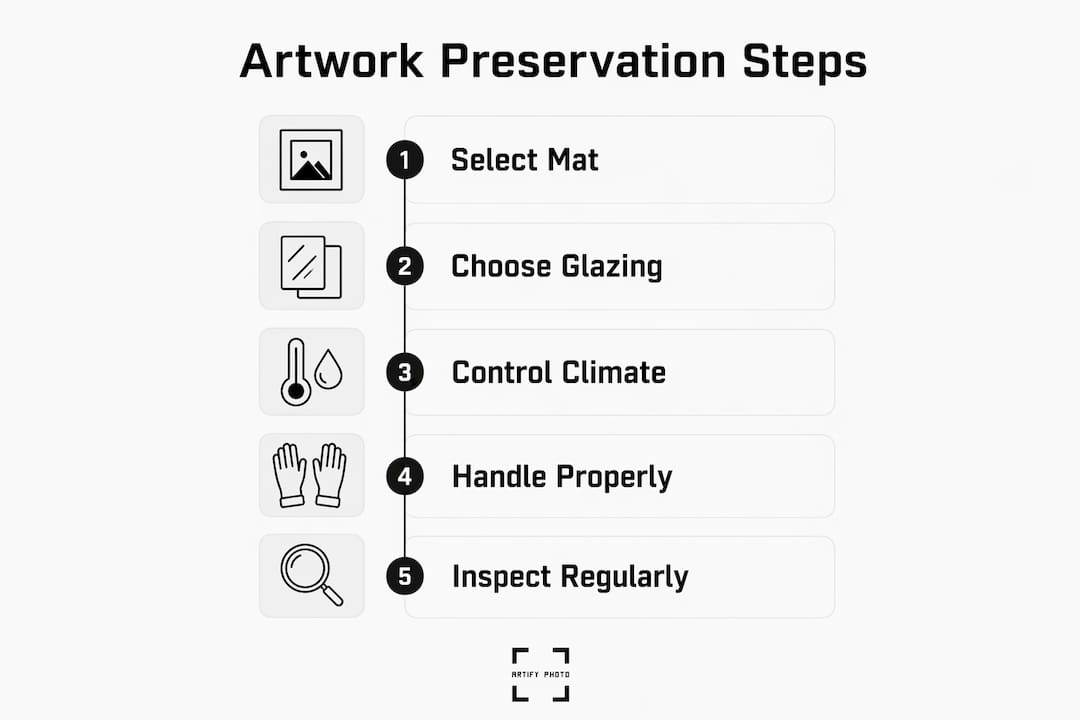
For mounting, the only acceptable methods are reversible ones. Japanese tissue hinges applied with refined wheat starch paste are the conservation standard. Pressure-sensitive tapes, including products marketed as “archival,” become brittle and acidic over time, stain the paper, and are nearly impossible to remove without causing further damage.
Key framing checklist:
- Mat board: Use 100% cotton rag or lignin-free board with sufficient ply thickness for protection
- Glazing: UV-filtering glass or acrylic (blocks nearly 99% of harmful UV rays)
- Backing board: Use an acid-free, lignin-free backing board of adequate thickness
- Moisture barrier: Metalized polyester film between backing and mat package
- Frame seal: Framer’s tape along all edges to slow air exchange
- Mounting: No nails to secure paintings; use metal mending plates screwed into the frame only
Pro Tip: Before handing a piece to a framer, ask them to confirm in writing that all materials meet Library of Congress preservation standards. A framer who cannot answer that question is not the right framer for a piece you care about.
What are the ideal storage conditions for artwork?
The target for paper art is a moderate relative humidity and steady, cool room temperature. Photographic prints require somewhat stricter control of humidity and temperature fluctuations.
High humidity above 65% creates conditions for mold and foxing. Low humidity below 30% causes paper to become brittle and crack, and paint layers to delaminate from their supports. Rapid cycling between wet and dry is worse than a steady state at either extreme, because the repeated expansion and contraction tears at fibers and paint layers over time.
Storage positioning matters too. Paper works should lie flat, never rolled or stored vertically in a way that causes slumping. Paintings store best upright, padded and separated from neighboring pieces. Avoid basements, attics, exterior walls, and any space near heating or cooling vents.
Environmental do’s and don’ts:
- Do use a calibrated hygrometer to monitor RH in every storage and display area
- Do store works in the dark; light damage is cumulative and irreversible
- Do keep storage areas clean and well-ventilated to deter pests
- Don’t store near fireplaces, radiators, or air conditioning vents
- Don’t place works on exterior walls without adequate insulation and vapor barriers
- Don’t stack unprotected works directly against each other
How should you handle and rotate artwork to prevent damage?
Proper handling starts before you touch the piece. Clear a flat, clean surface covered with acid-free tissue, remove all food and drinks from the area, and wash your hands thoroughly.
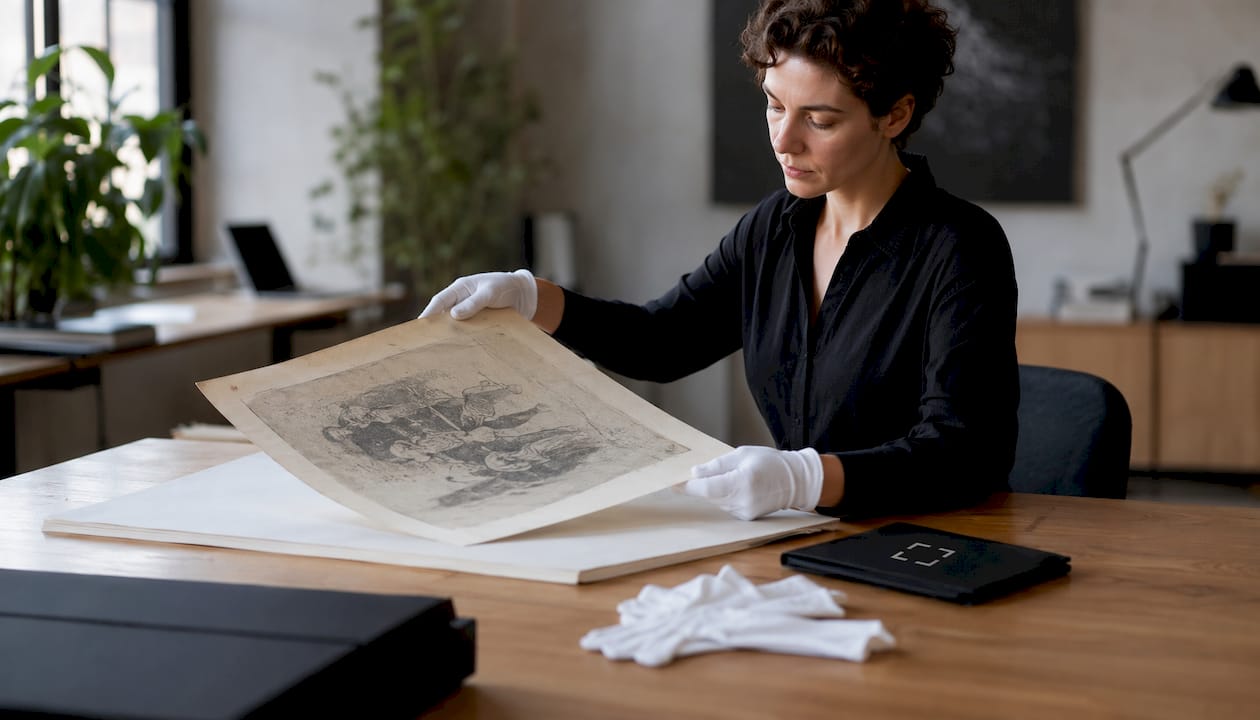
For most paper works, clean dry hands are preferable to cotton gloves. Gloves reduce tactile sensitivity and increase the risk of dropping a piece. The exception is photographs, particularly glossy silver gelatin prints, where even clean fingertips leave permanent marks. For those, use clean lint-free cotton or nitrile gloves. Always slide a rigid, acid-free support board under a work before lifting it. Never pick up a sheet by its edges or corners.
Rotating displayed paper works every 6–12 months is one of the most effective long-term habits you can build. No piece should stay on continuous display longer than that, even behind UV-filtering glazing. Rotation gives each work a rest from cumulative light exposure and creates a natural opportunity to inspect it closely.
Safe handling and inspection habits:
- Support the full surface area when lifting; never grip by corners or edges
- Inspect frames for loose joints, warping, or gaps in the dust seal
- Check mat boards for mat burn (orange-brown staining along cut edges)
- Look for insect frass, webbing, or surface grazing that signals pest activity
- Photograph condition issues before and after any handling or treatment
Pro Tip: Photograph every piece in consistent, even lighting, front and back, and include a ruler and color reference card in at least one shot. Store image files in at least two separate locations with descriptive filenames. This documentation is your baseline for insurance claims and conservation consultations.
Common mistakes that cause irreversible artwork damage
The most damaging mistakes are almost always made at the framing stage or during storage setup, not through dramatic accidents.
Using standard picture glass is one of the most common errors. Standard glass blocks zero UV radiation, leaving paper and pigments fully exposed to the wavelengths that break chemical bonds. UV-filtering glazing is not optional for any displayed work on paper.
Pressure-sensitive tapes are another frequent mistake. Even products labeled “archival” cause irreversible staining and are nearly impossible to remove cleanly. The same applies to dry-mounting and spray-mounting, which permanently bond the artwork to its support and destroy both physical integrity and resale value.
Common mistakes and their consequences:
- Non-archival mat board: Acid migration causes mat burn and paper embrittlement within years
- Direct contact with glazing: Moisture causes artwork to bond to glass, especially photographs and pastels
- Nails to secure paintings in frames: Vibration from nailing cracks paint layers
- Storage in attics or basements: Extreme temperature and humidity swings accelerate every form of deterioration
- Spraying cleaning fluid directly onto glazing: Liquid seeps behind the frame and causes staining or mold
- Tight framing with no room for expansion: Canvas and paper need space to move with humidity changes
Updated 2026 expert guidance on glazing and mounting
The Library of Congress preservation guidelines remain the clearest benchmark for framing standards in 2026. The core requirement has not changed: artwork must never touch the glazing, and the mat creating that gap must be at minimum 4-ply, 100% cotton rag or lignin-free board.
What has expanded is the glazing options available. UV-filtering acrylic now comes in anti-static versions, which are safe for pastels, charcoal, and graphite drawings where standard acrylic would disrupt powdery media through static charge. Anti-reflective UV glass offers museum-quality clarity for pieces where glare is a concern. For large-format works where acrylic tends to bow, UV-filtering laminated safety glass is the preferred choice.
Reversible mounting remains non-negotiable. Japanese tissue hinges with wheat starch paste or methyl cellulose are the conservation standard because they can be removed cleanly with moisture if the piece ever needs reframing or treatment. Any mounting method that cannot be reversed without risk to the artwork fails the basic test.
Current best-practice checklist for glazing and mounting:
- Confirm mat is 4-ply minimum, 100% cotton rag or certified lignin-free
- Specify UV-filtering glazing in writing with your framer
- Use anti-static acrylic for pastels, charcoal, and graphite works
- Choose laminated UV glass for oversized pieces
- Mount with Japanese tissue and wheat starch paste only; no pressure-sensitive adhesives
Pro Tip: Ask your framer whether their materials comply with the CCAHA matting and framing specifications. The Conservation Center for Art and Historic Artifacts publishes these standards and updates them regularly. A framer working to those specs will know the document by name.
How to clean and dust artwork safely
Cleaning artwork is one area where restraint is the right approach. For framed works, wipe the exterior glazing with a microfiber cloth lightly dampened with distilled water. Apply any cleaning solution to the cloth first, never directly to the glass or acrylic. Liquid that seeps behind a frame can cause staining and mold on the artwork itself.
For the surface of paintings, accumulated dust can usually be lifted with a soft, natural-bristle brush using light, sweeping strokes. Never use household cleaning products, compressed air canisters, or any wet method on a paint surface without consulting a conservator first. Paper works with surface dirt can sometimes be dry-cleaned with a soft brush or a specialized cleaning pad, but any work with water-sensitive inks or fragile media should go straight to a professional. Proper cleaning of a painting’s surface or repair of damage is a job for a certified conservator, not a DIY project.
How to identify and prevent pest damage to artwork
Silverfish, carpet beetles, book lice, and cockroaches all feed on paper, adhesives, and sizing. A single silverfish can leave irregular holes and surface grazing across a valuable print in one night. The Smithsonian Museum Conservation Institute has documented extensive insect damage in collections stored without active pest monitoring.
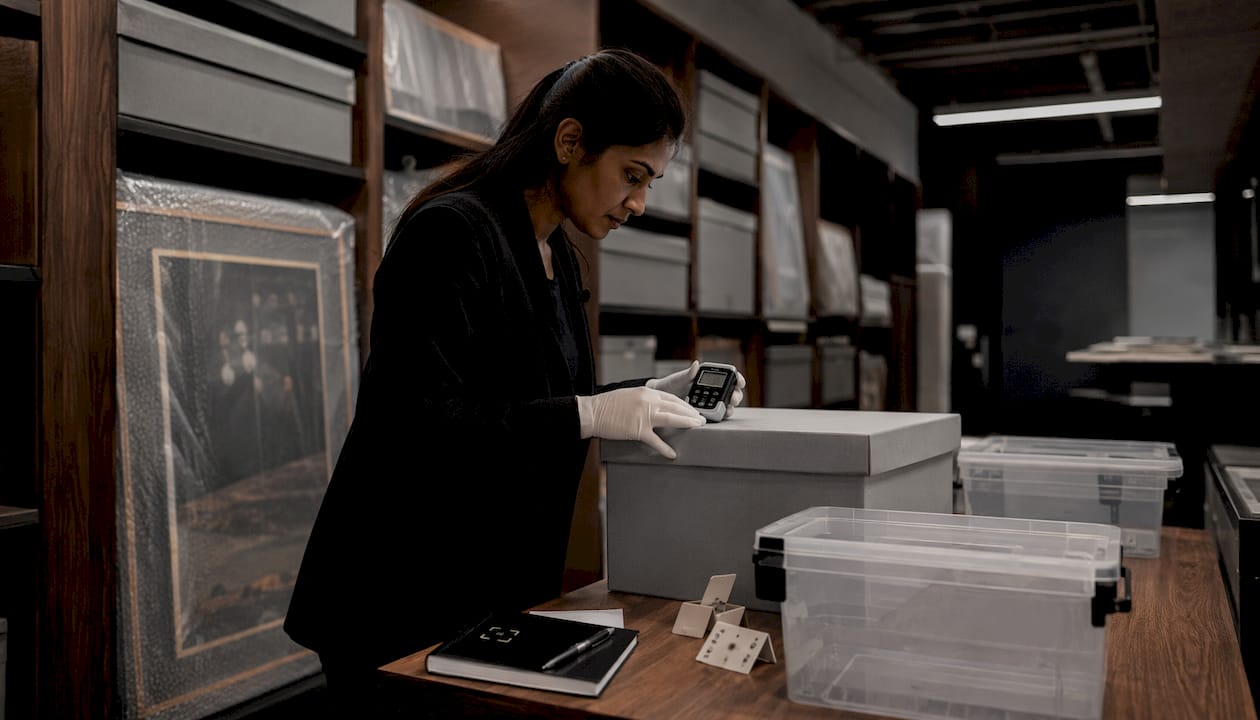
Prevention starts with the storage environment. Keep areas clean, reduce clutter where insects can shelter, and seal gaps around pipes and baseboards. Inspect incoming works before placing them near your existing collection, since pests often arrive on newly acquired pieces. Inside frames, a properly sealed dust seal slows insect access significantly.
Signs of active pest damage include small irregular holes, surface grazing, frass (fine powdery debris), webbing in corners, and shed insect casings near stored works. If you find active infestation, isolate the affected piece immediately in a sealed polyethylene bag and contact a conservator. Do not attempt fumigation or chemical treatment on the artwork itself.
Transportation and moving best practices
Moving a painting or framed work is one of the highest-risk moments in its life. Temperature and humidity can shift dramatically during transit, and physical shock is difficult to control. The Canadian Conservation Institute recommends wrapping paintings with a first layer of Mylar sheet followed by bubble wrap or thin polyethylene foam, then sealing the entire package in waterproof polyethylene sheeting with all seams taped.
Never transport a painting in an unheated vehicle in cold weather. Paint layers become brittle in the cold and crack under even minor vibration. Spring and fall are the safest seasons for moving art in northern climates, when temperature and humidity are most moderate. For valuable or oversized works, a hard-sided crate with interior padding is the only acceptable option.
Emergency preparedness for artwork protection
Water is the most common emergency threat to art collections, whether from flooding, burst pipes, or firefighting efforts. The first response for wet paper works is to air-dry them immediately, spread flat in a clean space with good airflow. If you cannot air-dry within 48 hours, freeze the works. Frozen paper art can be kept frozen until professional freeze-drying in a vacuum chamber is available, which is a standard conservation recovery method.
For paintings soaked in water, do not attempt to clean or dry the surface yourself. Lay the painting face-up on a clean surface and contact a conservator. Document the damage with photographs before touching anything. Keep a written inventory of your collection with condition photographs stored off-site or in cloud storage, so you have a baseline record for insurance claims after any emergency.
Digital documentation and cataloging artwork condition
Every piece in your collection deserves a written condition report. Record the medium, dimensions (image size and sheet size separately for works on paper), paper type, any existing damage, framing materials, and provenance. Update the report whenever the work is reframed, treated, or its condition changes visibly.
Photograph each piece in consistent, even lighting, capturing the full front, full back, and close-ups of any condition issues such as foxing, tears, or tape residue. Include a color reference card and ruler in at least one image. Store digital files in at least two separate locations, with descriptive filenames that include the artist name, title, and date of documentation. For collectors with larger holdings, dedicated collection management software keeps condition records, insurance appraisals, and loan histories organized in one place. Update insurance appraisals every three to five years, or after any significant treatment or acquisition.
Key Takeaways
Preserving artwork long-term requires archival materials, stable environmental conditions, and consistent handling habits, not expensive interventions after damage has already occurred.
| Point | Details |
|---|---|
| Use archival mat board | Minimum 4-ply, 100% cotton rag or lignin-free board prevents acid migration and keeps artwork off glazing. |
| Control humidity | Maintain stable relative humidity suitable for paper art; photographic prints need stricter control of humidity and temperature fluctuations. |
| UV-filtering glazing is mandatory | Standard glass blocks zero UV radiation; UV-filtering glass or acrylic blocks nearly 99% of harmful rays. |
| Rotate displayed paper works | No piece should stay on continuous display longer than 6–12 months, even behind UV-filtering glazing. |
| Document every piece | Condition photographs and written reports stored off-site are your baseline for insurance and conservation. |
FAQ
What is the best way to store artwork at home?
Store paper works flat in acid-free boxes in a cool, dark space with RH between 40%–55% and temperature around 65–75°F. Avoid basements, attics, and any area near heating or cooling vents.
Do I need UV-filtering glass for framed prints?
Yes. Standard picture glass blocks zero UV radiation, leaving paper and pigments fully exposed to the wavelengths that cause fading and embrittlement. UV-filtering glazing is required for any displayed work on paper.
How often should I inspect displayed artwork?
Check hygrometer readings monthly, open storage boxes quarterly to look for pests or mold, and rotate displayed paper works every 6–12 months to rest them from light exposure and allow close inspection.
Can I clean artwork myself?
Exterior glazing can be wiped with a microfiber cloth dampened with distilled water, applying solution to the cloth first. Surface cleaning of the artwork itself should be left to a certified conservator to avoid irreversible damage.
What should I do if artwork gets wet in an emergency?
Air-dry paper works flat within 48 hours. If that is not possible, freeze them until professional freeze-drying is available. Photograph all damage before handling and contact a conservator immediately.
If you are building a collection worth protecting, starting with gallery-quality prints made to archival standards gives you a head start. Artify produces custom wall art printed on archival materials, so the preservation work you put in actually has something worth preserving. Browse Artify’s curated art collections to find pieces ready for proper framing and long-term display.