


TL;DR:
- Custom sizing transforms artwork from accidental to intentional by ensuring perfect fit and visual balance. It enhances space perception, viewer engagement, and emotional comfort, especially with large or unusual walls. Planning with mock-ups and understanding scale guides creates cohesive gallery walls tailored to the space.
Custom sizing is the single most powerful tool collectors have for making artwork feel intentional rather than accidental. A piece that fits its wall with precision reads as designed. One that doesn’t creates a nagging visual tension most people feel but can’t name. The role of custom sizes in gallery art goes far beyond aesthetics: it determines how a space feels, how a viewer engages, and whether art becomes part of a room or simply hangs on it. Industry standards like the 2/3 rule and the concept of visual hierarchy give collectors a framework, but custom art dimensions are what make those principles work in real spaces with real furniture.
What industry standards guide artwork sizing?
The 2/3 rule is the most widely applied standard in gallery art sizing. It states that artwork width should cover 66%–75% of the furniture width below it to maintain visual balance. That means a six-foot sofa calls for artwork that spans roughly 48–54 inches wide. The rule exists because the eye naturally anchors floating objects to the largest horizontal surface nearby. When artwork falls short of that threshold, the result is what designers call the “postage stamp effect.”
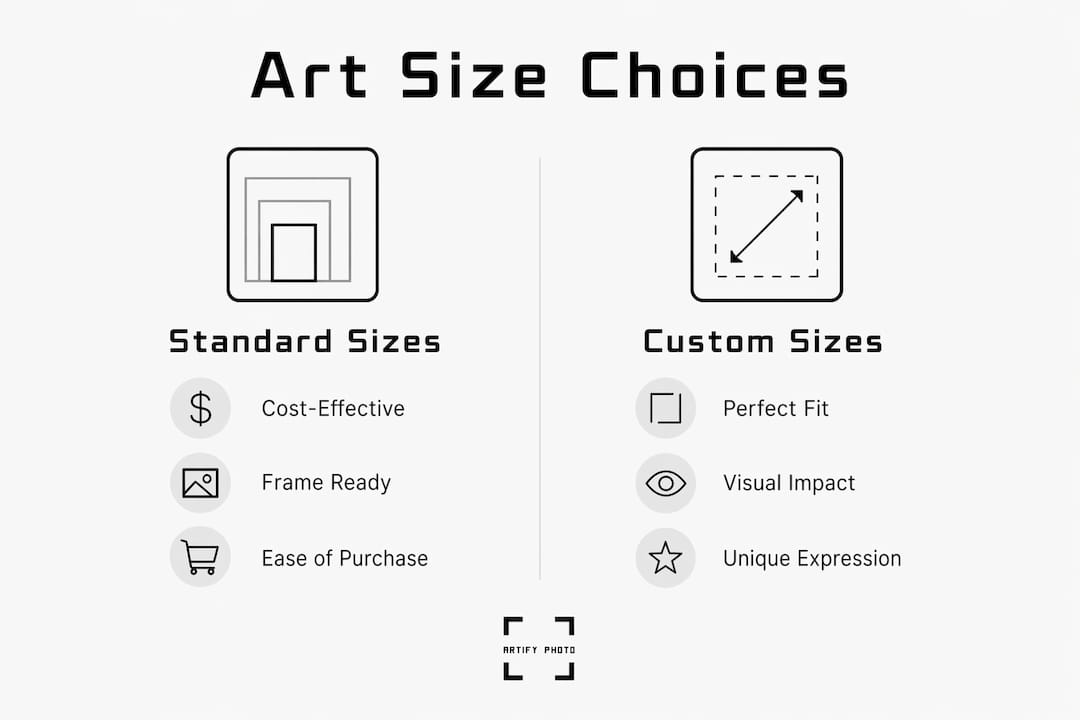
The postage stamp effect is exactly what it sounds like: a small piece marooned above a large piece of furniture, looking lost rather than placed. Standard sizes like 11x14 or 16x20 inches work well for general decor, but they rarely match the specific width of a custom sofa, a built-in bookcase, or an architectural alcove. That gap is where custom dimensions earn their place.
For rooms without furniture anchoring the wall, the standard shifts. Artwork should cover 30%–40% of wall area to feel proportionate without overwhelming the space. This is harder to achieve with off-the-shelf sizes, which is why collectors working with large or unusually shaped walls almost always need custom options.
Pro Tip: Before ordering, tape paper cutouts of your intended dimensions to the wall and live with them for a day. What looks right in your head often reads differently at scale in the actual room.
Standard vs. custom: when each makes sense
Standard sizes offer one major advantage: they fit standard frames, which keeps costs down. An 8x10 or 18x24 print drops into a widely available frame without custom matting. For collectors building large gallery walls, mixing standard sizes for smaller accent pieces and reserving custom dimensions for anchor works is a cost-effective approach. Collectors can order custom image areas printed on standard paper or canvas sizes, using common frames while still achieving a unique visual footprint.
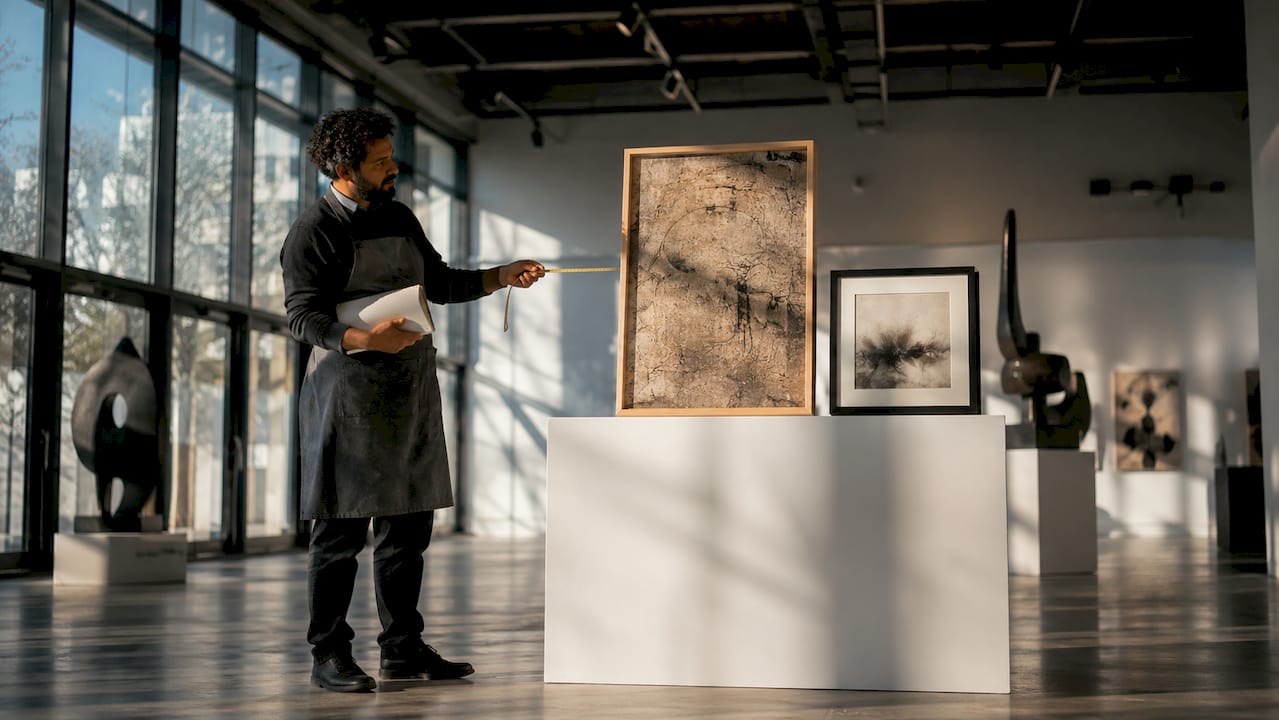
Diptychs and triptychs offer another path for large walls. Splitting a wide composition across two or three panels creates the visual mass of an oversized piece while keeping each panel manageable in size and framing cost. This modular approach also adds rhythm to a gallery wall, which a single large canvas cannot.
How does scale affect viewer perception and emotional safety?
Scale is not a passive quality in art. Large-scale works function as environments, inviting the viewer to navigate them rather than simply observe. A 60x40-inch canvas pulls a person into its world. A 12x16-inch print of the same image asks the viewer to lean in and look. These are fundamentally different experiences, and neither is wrong. But they serve different purposes in a space.
“A balanced gallery wall typically includes 3–4 distinct frame sizes with at least one large anchor piece (16x20 or larger). Proper scale lowers the viewer’s vigilance, contributing to emotional comfort in the space.”
That insight from research on emotional safety in art spaces reframes how collectors should think about sizing. A well-scaled anchor piece doesn’t just look good. It makes the room feel safer and more settled. Undersized art does the opposite: it creates low-level visual tension that makes a space feel unresolved.
Scale also changes the visual language of an artwork at a fundamental level. A small figure in a painting and a large figure in the same painting are effectively different artworks because scale alters how the viewer relates to the subject. Color reads differently at large scale. Texture becomes tactile. Fine detail that reads as delicate at 12 inches becomes commanding at 48 inches.
Here is how scale shifts the viewer’s experience across size categories:
- Small works (under 16 inches): Draw the viewer close. Best for intimate spaces, reading nooks, or grouped arrangements where proximity is expected.
- Medium works (16–30 inches): The most versatile range. Work well as secondary pieces in gallery walls or as standalone art in mid-sized rooms.
- Large works (30–48 inches): Anchor a wall or a room. Create the emotional grounding that makes a space feel complete.
- Oversized works (above 48 inches): Function as architectural elements. They define the room rather than decorate it.
Understanding how art scale influences mood helps collectors make deliberate choices rather than defaulting to whatever size is available.
How to plan custom sizes for a gallery wall
Planning a gallery wall without a layout strategy produces chaos. The most reliable method is to use paper templates or digital mock-ups to test size combinations before committing to prints or frames. Trace each piece on kraft paper, cut it out, and tape the shapes to the wall. Rearrange until the grouping has visual rhythm.
A cohesive gallery wall follows a few consistent principles:
- Establish one anchor piece first. Place the largest work at eye level in the center of the arrangement, then build outward.
- Mix three or four distinct size categories. Repeating the same size creates monotony. Varying sizes creates movement.
- Maintain consistent spacing. Two to three inches between frames reads as intentional. Wider gaps make the arrangement feel scattered.
- Use odd numbers. Groups of three or five pieces feel more natural to the eye than even-numbered groupings.
- Align at least one edge. Lining up the tops or bottoms of adjacent pieces gives the arrangement structure without making it rigid.
Pro Tip: When mixing custom and standard sizes on a gallery wall, let the custom piece set the visual tone. Size everything else in relation to it, not in relation to the wall.
The importance of custom sizes becomes clearest when a collector is working with an unusual wall shape, a fireplace surround, or a staircase. Standard sizes simply don’t account for those variables. Custom dimensions do.
| Scenario | Best approach |
|---|---|
| Wide sofa wall | Custom width to meet the 2/3 rule; standard height |
| Staircase gallery | Graduated sizes following the stair angle |
| Narrow hallway | Vertical custom formats; limit to one or two pieces |
| Large open wall | Oversized anchor or modular triptych arrangement |
What happens artistically when you resize a work?
Resizing artwork is not a mechanical process. Artwork resizing requires rethinking composition and material durability, not just scaling pixels or canvas dimensions. A composition that works at 16x20 may feel unbalanced at 40x50 because the negative space that felt restful at small scale becomes oppressive at large scale. Artists who work at large formats often redesign rather than simply enlarge.
“Bespoke canvases aid archival longevity and prevent warping. Technical scaling changes may sacrifice fine detail and require structural support considerations.”
That material reality matters for collectors buying for the long term. Standard canvases are engineered for standard sizes. A custom 36x72-inch canvas needs a different internal support structure to prevent sagging over time. Bespoke production accounts for that. Off-the-shelf resizing often doesn’t.
Resolution is the other technical constraint. A photograph printed at 8x10 at high quality may lose sharpness at 30x40 if the original file lacks sufficient resolution. Collectors working with Artify’s custom art creation process benefit from professional guidance on file requirements before committing to large-format prints. Getting the technical foundation right protects both the investment and the visual result.
For collectors exploring art printables and creative projects, understanding the relationship between file resolution and print size is the first practical step toward confident custom ordering.
Key Takeaways
Custom sizing is the defining factor between art that fits a space and art that transforms it. Collectors who apply proportional standards and plan their layouts deliberately get consistently better results.
| Point | Details |
|---|---|
| Apply the 2/3 rule | Artwork width should cover 66%–75% of the furniture width below it for visual balance. |
| Use an anchor piece | Every gallery wall needs at least one large work (16x20 or bigger) to create emotional grounding. |
| Plan before you order | Paper templates or digital mock-ups prevent costly size mismatches before printing. |
| Resize with intention | Drastic size changes require compositional redesign, not just scaling, to preserve visual integrity. |
| Mix standard and custom | Use standard sizes for accent pieces and custom dimensions for anchor works to manage costs. |
Why I think collectors underestimate the power of size
Most collectors spend significant time choosing the right image and almost no time choosing the right size. That’s a mistake. The image is the content. The size is the experience. A photograph of a coastline at 12x16 is a memory. The same photograph at 40x60 is a place you can stand in front of and feel the wind.
The misconception I see most often is that custom sizing is a luxury reserved for large budgets or professional installations. It isn’t. Customization has become a core expectation in the art market, and the cost difference between a standard and a custom size is often smaller than collectors expect. What changes dramatically is the result.
The other thing worth saying plainly: scale is a design choice, not a default. Choosing a size because it was available is not the same as choosing a size because it’s right for the wall, the room, and the feeling you want to create. Collectors who treat size as an active decision rather than a constraint consistently build more cohesive, more emotionally resonant spaces. The 2026 wall art trends reflect this shift, with personalization and intentional scale becoming the defining characteristics of how serious collectors approach their spaces.
Size is not a detail. It is the decision.
— Artify
Custom sizes, made to fit your space
Artify produces custom-dimension artwork without setup fees, so the size that works for your wall is the size you can order. Whether you’re building a gallery wall around a specific anchor piece or filling an architectural feature that no standard size addresses, the process starts with your vision.
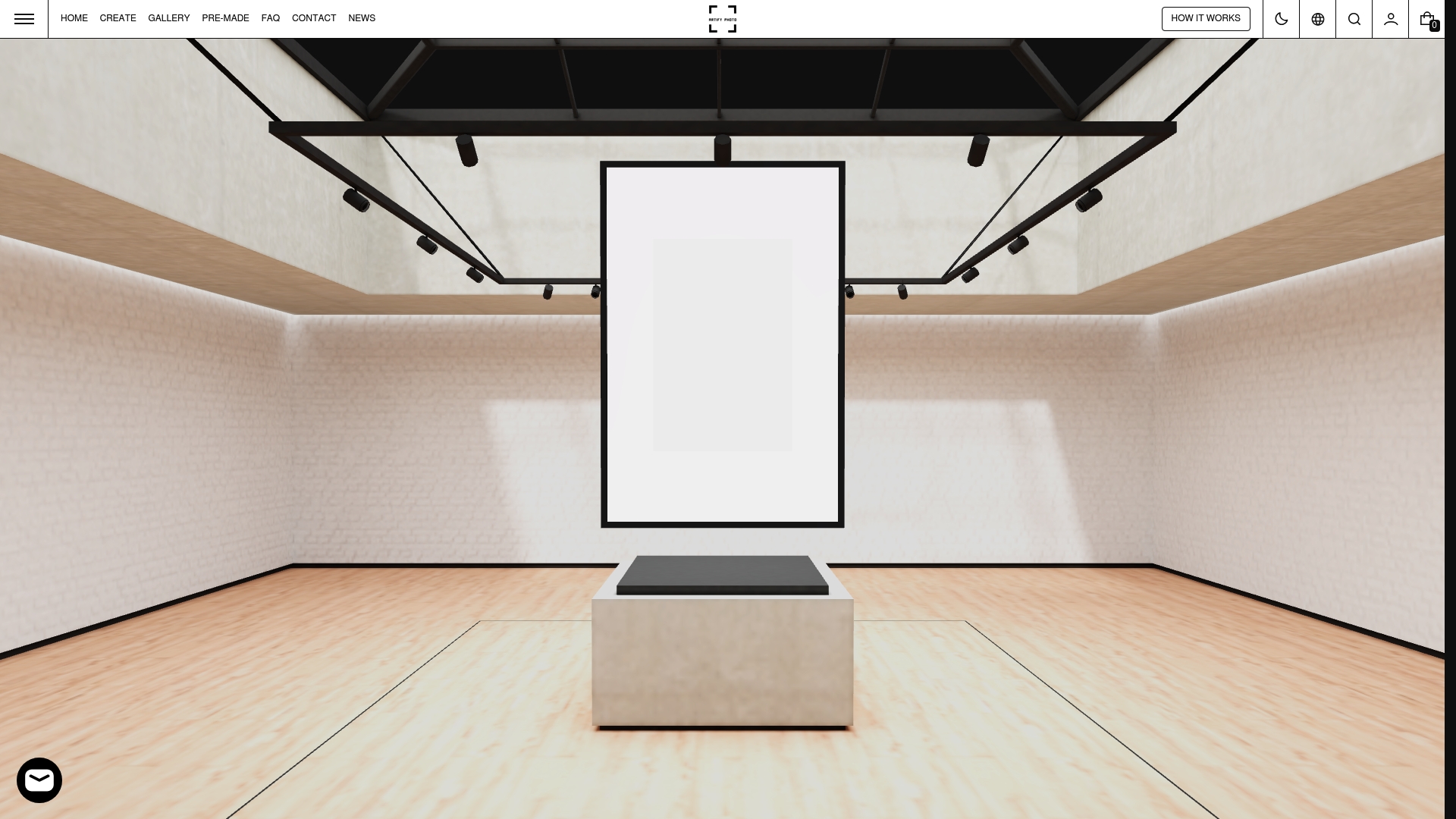
Browse Artify’s pre-made collections to find works available in flexible sizes, or use the creating your art guide to commission a piece built to your exact dimensions. Every order includes professional guidance on sizing, resolution, and framing to make sure the result matches what you imagined. For collectors who want art that fits the space rather than a space that accommodates the art, custom dimensions are the starting point.
FAQ
What is the 2/3 rule in gallery art sizing?
The 2/3 rule states that artwork width should cover 66%–75% of the furniture width below it. For rooms without furniture anchoring, artwork should fill 30%–40% of the total wall area.
Does size really matter in art display?
Size determines how a viewer engages with a work. Large-scale pieces function as environments that draw viewers in, while undersized art creates visual tension and makes a space feel unresolved.
When should I choose custom art dimensions over standard sizes?
Custom dimensions are necessary when standard sizes fail to meet the 2/3 rule for your furniture, when you’re working with an unusual wall shape, or when you need a specific visual hierarchy in a gallery arrangement.
Can I resize any artwork to a custom size?
Resizing requires more than scaling. Drastic changes in size affect composition, material structure, and detail clarity. Large custom formats need proper canvas support and sufficient file resolution to maintain quality.
How do I plan a gallery wall with mixed sizes?
Start with one large anchor piece at eye level, then build outward using three or four distinct size categories. Maintain 2–3 inches of consistent spacing between frames and align at least one edge across adjacent pieces.