


TL;DR:
- Artify.photo is the best all-around online framing service in 2026, offering customization and AR previews. Buyers increasingly want museum-grade glazing and visualization tools for high-value artwork, making Artify’s features essential. Alternatives like Framebridge, Frameology, and Level Frames serve specific needs such as simplicity, premium materials, or UV protection.
For most U.S. buyers who want gallery-quality framed art with modern visualization tools and clear delivery policies, Artify.photo is the strongest all-around choice in 2026. It combines pre-made collections, fully custom framed prints, 3D/AR room previews, and museum-grade glazing options in a single end-to-end online experience.
If your needs are more specific, here are the top alternatives worth knowing:
- Framebridge — best for a simple, template-driven ordering experience with broad consumer visibility
- Frameology — best for buyers who want premium U.S.-made frame materials and gallery-style finishes
- Level Frames — best for pieces that need enhanced UV protection and specialized glazing
The core decision comes down to four things: how much customization you want, whether you need conservation-grade glazing, how fast you need the piece, and what your budget looks like. Artify.photo covers all four for most buyers, with the added advantage of AR previews that let you see the finished frame on your actual wall before you order.
Table of Contents
- What are the top framed art services in 2026?
- How we picked and evaluated this shortlist
- What does each top pick actually offer?
- How do you choose the right framer for your piece?
- How do you plan and install framed art at home?
- Common framing mistakes that cost you money and quality
- Why Artify.photo stands out among 2026 framing services
- Key Takeaways
- The framing market has quietly raised the bar
- Ready to order framed art? Here is where to start with Artify
- Sources and further reading
- FAQ
What are the top framed art services in 2026?
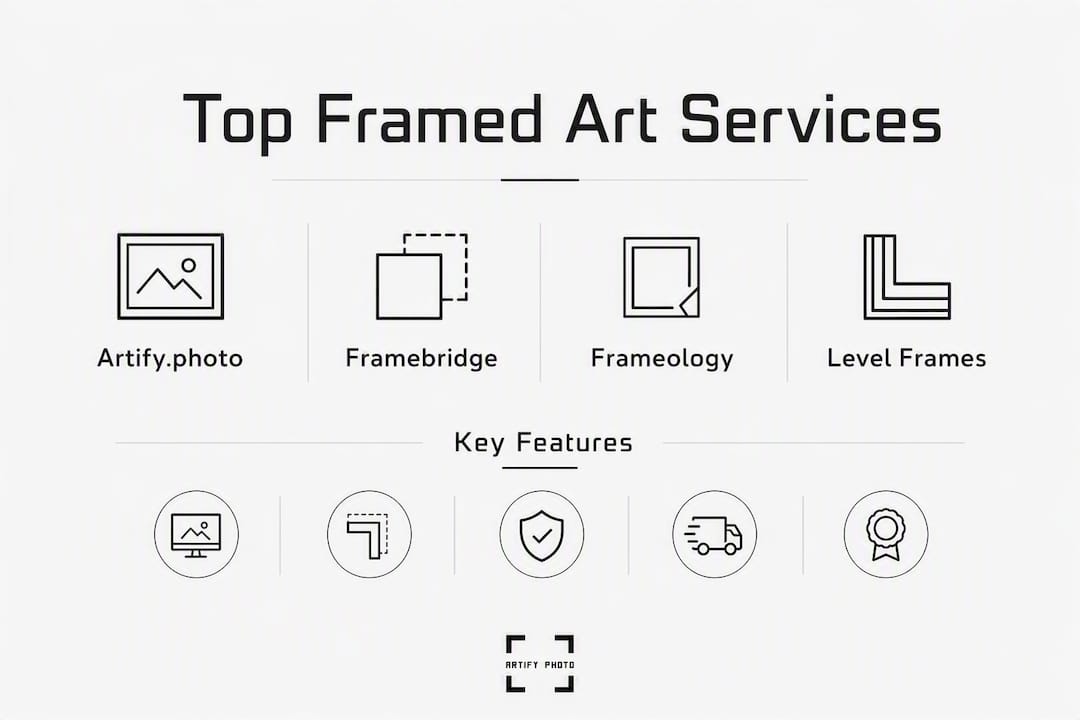
The table below compares the four leading online framers on the dimensions that actually matter at checkout.
| Service | Best for | Price range | Turnaround time | Customization level | AR/preview tools | Gallery/museum-grade options |
|---|---|---|---|---|---|---|
| Artify.photo | End-to-end custom or pre-made framing with visualization | Mid–Premium | Varies by order; see ordering details | Fully custom + pre-made collections | 3D/AR room preview | Museum-grade giclée, conservation glazing |
| Framebridge | Easy online ordering for photos and prints | Budget–Mid | Typically 1–2 weeks | Template-based | Limited preview tools | Standard options |
| Frameology | Higher-end materials with user-friendly online flow | Mid–Premium | Typically 1–2 weeks | Templates + some customization | Room visualization tools | Premium U.S.-made frames, gallery finishes |
| Level Frames | UV protection and specialized glazing for sensitive pieces | Mid–Premium | Typically 1–2 weeks | Templates + glazing options | Basic preview | Premium UV-protective glazing |
A note on pricing: Online framing prices shift frequently. Always check each service’s current product pages before ordering, since promotional pricing and material upgrades can move the effective cost significantly.
Buyers in 2026 increasingly prioritize AR/3D previews and explicit glazing specs — UV protection and anti-reflective museum glass — when choosing a framer. Services that publish clear material details and let you visualize the finished piece in your room before checkout have a measurable advantage in reducing buyer hesitation on higher-ticket orders.
How we picked and evaluated this shortlist
The goal was a shortlist a real buyer could act on, not a list padded with every service that has a website. Here is what shaped the picks.
Evaluation axes used:
- Best-for alignment — does the service genuinely serve a distinct buyer need?
- Price range and typical turnaround time
- Frame styles and material options (wood, metal, profile depth)
- Customization level (fully custom vs. template-based workflows)
- AR/preview and room-visualization tools
- Shipping, returns, and warranty policies
- Gallery-grade options: giclée printing, conservation glazing, acid-free matting
How picks were validated:
- Product page review for each service: materials listed, glazing specs disclosed, pricing structure
- Ordering and checkout flow review: how easy is it to configure a custom frame?
- Published help and policy pages: shipping timelines, returns process, damage claims
- Third-party testing: Wirecutter’s 2026 review tested orders from eight services and named Framebridge its top pick, with Level Frames as an “also great” runner-up. That independent testing informed how those two services are positioned here.
- Artify.photo’s frame materials page, ordering documentation, and pre-made collections were reviewed directly.
What was not tested: In-person installation, local pickup, and in-store framing consultations were outside the scope of this review. If you need hands-on service or want to see physical samples before committing, a local custom framer or a service like Skyframe (which operates in NYC, NJ, and Miami) is worth considering alongside these online options.
What does each top pick actually offer?
Artify.photo
Artify.photo operates as a direct-to-consumer platform with two distinct entry points: a pre-made collections catalog of ready-to-ship framed prints, and a fully custom flow where you upload a photo and configure frame, mat, and glazing from scratch. The platform’s 3D room preview lets you place the finished piece on a photo of your actual wall before ordering, which is the single most useful tool for avoiding size regret on larger pieces.
On the materials side, Artify offers museum-grade giclée printing and conservation glazing options, documented on its Our Frames page. The artist-collab program adds a collector angle: limited-edition runs with curated artists, which suits buyers who want something beyond a standard print.
Top strengths:
- End-to-end custom framing with AR/3D room preview
- Museum-grade giclée and conservation glazing available
- Pre-made collections for buyers who want a faster, lower-decision path
- Clear ordering and delivery documentation and a dedicated returns page
- Artist-collab limited editions for collector-focused buyers
Trade-offs: As a fully online platform, there are no physical showrooms. Buyers who want to touch frame samples before committing will need to rely on the digital preview tools and published material specs.
Pro Tip: Use Artify’s 3D room preview with a photo of your actual wall at the correct scale. Sizing errors are the most common reason buyers are disappointed with framed art, and the preview tool eliminates most of them before checkout.
Framebridge
Framebridge built its reputation on making custom framing feel less intimidating. The ordering flow is template-driven: you pick a frame style, upload your image or ship your physical piece, and the service handles the rest. Wirecutter named Framebridge its top pick after testing eight services, citing its consistent quality and straightforward experience. Price bands are consumer-friendly, and turnaround typically runs one to two weeks. The trade-off is limited flexibility on glazing specs and fewer conservation-grade options compared to services that cater to collectors.
Frameology
Frameology targets buyers who want a step up in frame quality without moving to a fully bespoke workflow. Frames are U.S.-made, and the platform offers gallery-style finishes that hold up well in more formal room settings. The online preview tools are solid, and the ordering experience is clean. It sits at the mid-to-premium price point, so it is not the cheapest option, but the material quality justifies the difference for buyers who care about the frame itself, not just the print inside it.
Level Frames
Level Frames is the clearest choice when UV protection is the primary concern. The service publishes explicit glazing option disclosures, which matters when you are framing a piece that will hang in a sun-exposed room. Wirecutter listed it as an “also great” runner-up, and its glazing transparency is genuinely better than most online framers. If you are framing a watercolor, a signed print, or anything with pigments that fade under direct light, Level Frames is worth the price premium for the glazing upgrade alone.
How do you choose the right framer for your piece?
The right service depends on the piece, not just the price. Work through this checklist before you order.
Decision checklist:
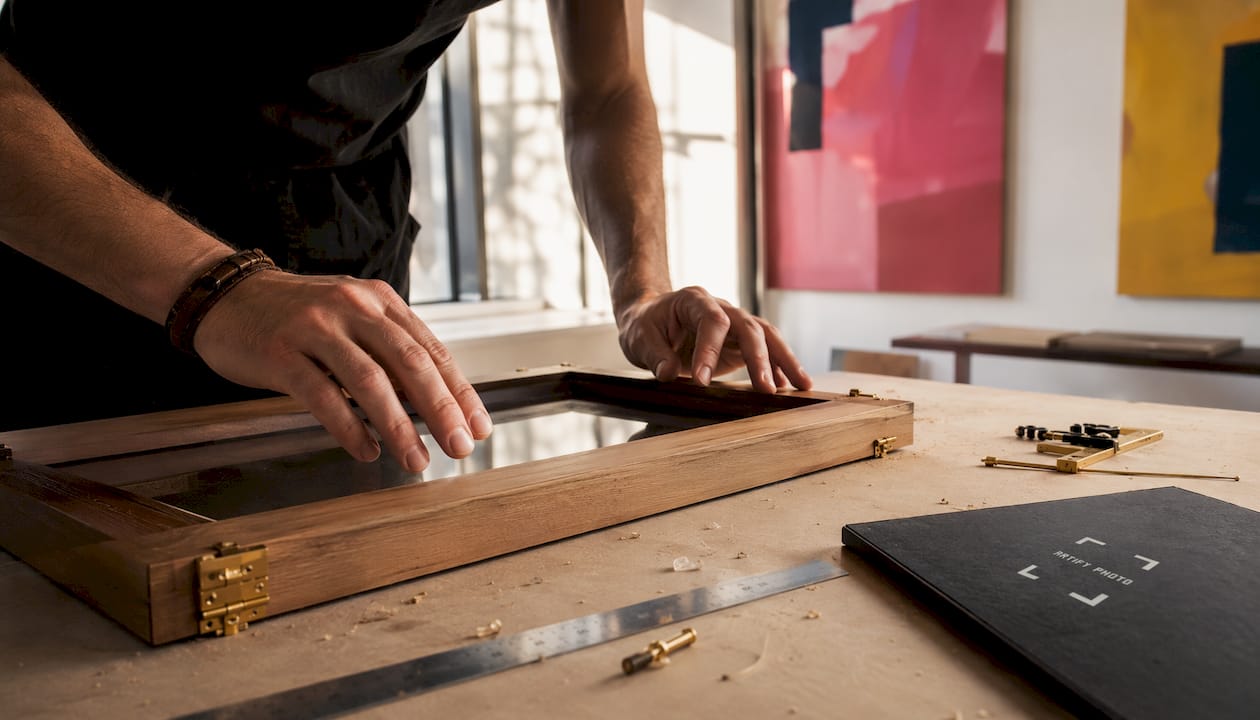
- Artwork value — Is this a one-of-a-kind piece, a limited edition, or a standard print? Higher-value work warrants conservation glazing and acid-free mounting.
- Sun exposure — Will the frame hang in direct or indirect sunlight? UV-blocking glazing is non-negotiable for sunlit walls.
- Desired permanence — Are you framing for décor or for a collection? Collector-grade framing (giclée, museum glass, float mount) costs more but lasts decades longer.
- Size and weight — Large-format pieces need heavier hardware and, often, professional installation. Confirm the service ships and insures large formats before ordering.
- Budget — Budget framers can produce good results for standard prints. For anything archival, the glazing and mat upgrades are worth paying for.
Questions to ask before ordering:
- What glazing options are available, and are UV-blocking specs published?
- Is the mat board acid-free? What is the backing material?
- How is the artwork mounted — hinge, float, or dry mount?
- Is shipping insured, and what happens if the frame arrives damaged?
- What is the returns window, and does it cover custom orders?
- Are installation services or hardware included?
Red flags to watch for:
- Glazing described only as “glass” or “acrylic” with no UV or anti-reflective spec
- No sample photos of finished frames in real rooms
- Missing or vague damage/returns policy for custom orders
- Pricing that only becomes clear at the final checkout step
Interior color and style trends also influence frame and mat choices. Warm wood tones and natural finishes have been dominant in 2025–2026 interiors, which makes natural oak and walnut profiles a safe default for most rooms. Artify’s framed art selection guide covers sizing and style matching in more detail if you want a deeper framework.
How do you plan and install framed art at home?
Getting the frame right is only half the job. A piece that is hung at the wrong height or in the wrong position on a wall can undercut even the best framing.
Step-by-step installation guide:
- Measure the wall and the piece. Note the wall’s width and height, the furniture below it (sofa, bed, console), and the available hanging zone. A standard rule: the center of the frame should sit at eye level, roughly 57–60 inches from the floor.
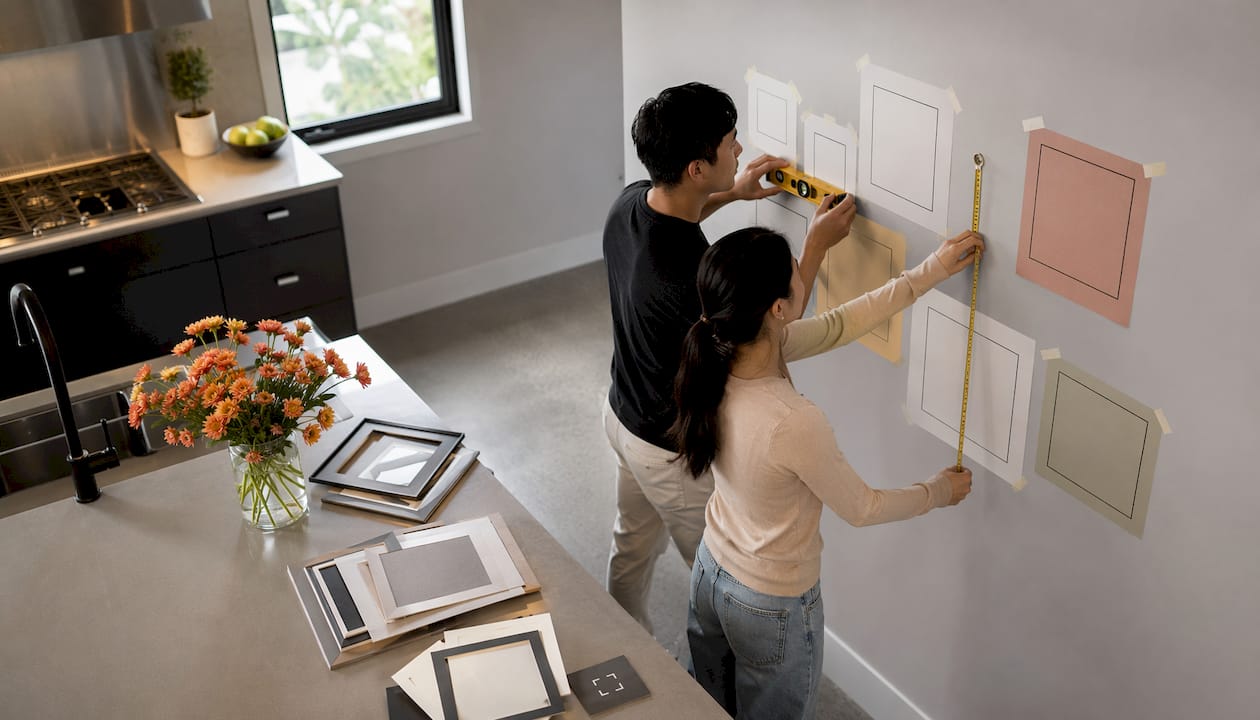
- Create a mock-up before you commit. Cut paper templates to the exact frame dimensions and tape them to the wall. For a gallery wall with multiple pieces, lay all templates on the floor first to test the arrangement. Artify’s AR room preview does this digitally, which is faster and more accurate for single pieces.
- Choose hardware for the weight. Frames under 20 lbs can typically hang from a single picture hook into a stud or a wall anchor. Heavier frames need two anchor points and, ideally, a stud. Use a stud finder before drilling.
- Mark and hang precisely. Use a level on every piece, even if your eye says it looks straight. For gallery walls, measure the spacing between frames consistently — 2–3 inches between pieces is a standard starting point.
- Check the final result at distance. Step back to the room’s natural viewing distance (usually 8–10 feet) before calling it done. What looks right up close often reads differently from across the room.
Pro Tip: For a gallery wall with more than three pieces, photograph your paper mock-up on the wall and compare it to the AR preview before ordering. The two views together catch scale problems that neither catches alone.
For a room-by-room breakdown of where to hang and what sizes work where, Artify’s room-by-room guide is a practical reference.
Common framing mistakes that cost you money and quality
Most framing regrets are avoidable. These are the errors that come up most often.
- Wrong glazing for the location. Standard glass transmits UV light freely. Hang a watercolor or a signed print in a sunny room without UV-blocking glazing, and you will see fading within a few years. Always specify UV-protective glazing for any piece you care about.
- Acidic mats and backing boards. Cheap mat boards contain acids that migrate into the artwork over time, causing yellowing and brittleness. Acid-free, conservation-grade boards are the baseline for anything you want to last.
- Dry mounting valuable pieces. Dry mounting bonds the artwork permanently to a backing board. It is fast and cheap, but it destroys the piece’s resale value and makes restoration impossible. Use hinge mounting or float mounting for anything original or limited edition.
- Underestimating shipping risk. Custom framed pieces are fragile. If a service does not insure shipments or has a vague damage policy, you are absorbing the risk. Confirm insurance coverage before you order.
- Poor gallery wall layout. The most common hanging mistake is placing frames too high and too far apart. Frames hung above eye level and spaced more than 4 inches apart lose visual cohesion. Tape templates to the wall first, every time.
- Ignoring frame-to-art proportion. A frame that is too thin looks cheap on a large print; one that is too wide overwhelms a small piece. A general rule: the mat width should be at least 2–3 inches for prints larger than 11×14.
Pro Tip: If you are unsure about glazing specs, ask the framer to confirm whether the glazing blocks UV-A and UV-B wavelengths and what the visible light transmission percentage is. A framer who cannot answer that question is not using conservation-grade glass.
Why Artify.photo stands out among 2026 framing services
Artify.photo’s strongest differentiator is the combination of visualization technology and collector-grade options in a single consumer-facing platform. Most online framers offer one or the other. Artify offers both.
Platform capabilities:
- 3D/AR room preview — place the finished frame on a photo of your actual wall before ordering, at true scale
- Museum-grade giclée printing — archival pigment inks on fine art paper, with frame materials that include conservation glazing options
- Pre-made collections — curated, ready-to-ship framed prints for buyers who want a faster path
- Artist-collab limited editions — numbered, curated runs through the Collabs program for collectors
- Clear policy documentation — dedicated help pages for ordering and delivery and returns
Use-case examples:
- Gift framing: Upload a personal photo, configure a frame and mat, use the AR preview to confirm scale, and ship directly to the recipient. The pre-made collections also work well as ready-to-give gifts.
- Collector-grade limited editions: The artist-collab workflow supports numbered editions with curated framing, suited to buyers building a collection rather than just decorating.
- Large-format gallery walls: The 3D preview is particularly useful here. Planning a multi-piece wall without a visualization tool is guesswork; with it, you can test arrangements and proportions before committing to a single order.
Artify’s art philosophy page explains how the platform supports both casual buyers and serious collectors, which is a useful read if you are deciding between a standard print and a collector-grade framed edition.
Key Takeaways
Artify.photo is the strongest all-around choice for U.S. buyers who want gallery-quality framed art with AR previews, museum-grade options, and clear delivery policies in 2026.
| Point | Details |
|---|---|
| Best overall pick | Artify.photo covers custom framing, pre-made collections, AR previews, and museum-grade glazing in one platform. |
| Conservation glazing matters | UV-blocking, anti-reflective glazing is non-negotiable for sunlit walls or any piece with long-term value. |
| When to choose an alternative | Framebridge for simplicity; Frameology for premium U.S.-made frames; Level Frames for specialized UV glazing. |
| Installation starts with measurement | Hang frames at 57–60 inches center height; use paper templates or AR previews before drilling. |
| Artify’s next step | Browse Artify’s pre-made collections or start a custom order and use the 3D room preview before checkout. |
The framing market has quietly raised the bar
The conventional wisdom on online framing used to be: pick the cheapest service that ships fast and does not break the glass in transit. That was a reasonable standard when most buyers were framing casual prints for a rental apartment.
What has changed in 2026 is who is buying and what they expect. Buyers are framing pieces they actually care about — limited editions, personal photographs printed at archival quality, artwork they paid real money for. When the piece matters, the framing has to match. A standard acrylic front and an acidic mat board are not acceptable for a $300 giclée print, and buyers increasingly know that.
The AR preview shift is equally real. Hanging a frame in the wrong spot, at the wrong size, is the most expensive mistake in home décor. It is also the most preventable. Services that let you visualize the finished piece in your actual room before ordering have removed the single biggest source of buyer regret. That is not a feature — it is a fundamental change in how the purchase decision works.
Conservation glazing has moved from a specialty add-on to a baseline expectation for anyone framing something worth keeping. UV-blocking, anti-reflective glass used to be the domain of galleries and museums. Now it is available from consumer-facing online services, and the buyers who know to ask for it are growing. If you are framing something you want to look the same in twenty years, the glazing spec is the most important line item in the order.
The 2026 art style trends are also pushing buyers toward more considered framing choices. Styles that emphasize texture, depth, and material quality do not work in a thin black frame with standard glass. The frame is part of the piece now, not just a border around it.
Ready to order framed art? Here is where to start with Artify
Artify.photo gives you two clear entry points. If you want something ready to ship, the pre-made collections are curated, framed, and available now — no configuration required. If you want something built around your own photo or a specific size and finish, the custom framing flow walks you through frame selection, mat options, and glazing, with a 3D room preview at every step so you can see the result before you commit.
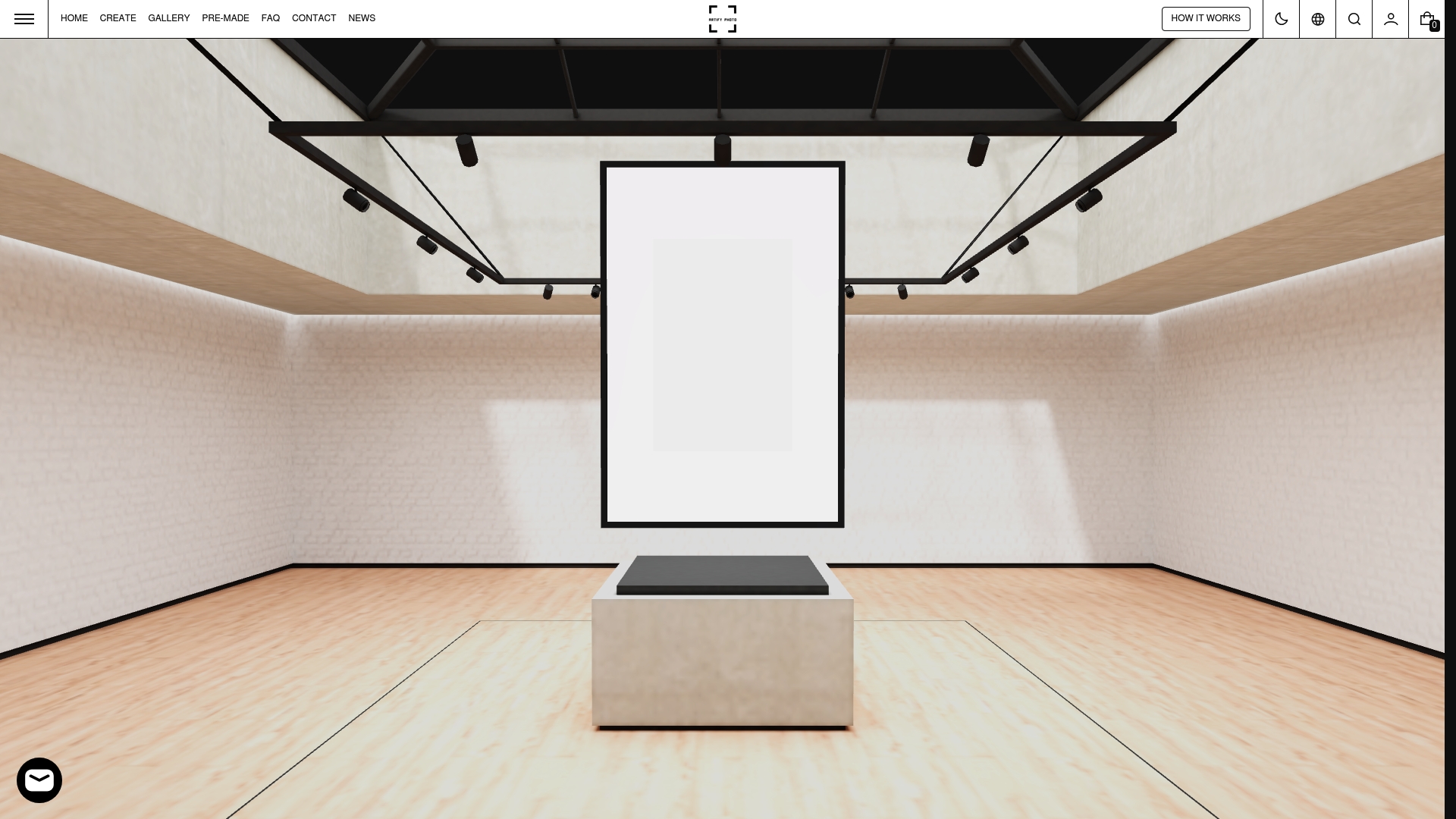
The ordering process is documented clearly: upload or select, configure, preview, and order. Delivery timelines and shipping details are published on the ordering and delivery page, and the returns process is spelled out if anything arrives damaged. For buyers who want collector-grade framing with a direct line to independent artists, the Collabs program is worth exploring for limited-edition runs. Start with a pre-made piece or a small custom print to see the quality firsthand, then scale up from there.
Sources and further reading
The following sources were used in this article. Artify pages are marked accordingly.
- Wirecutter: The 2 Best Online Framing Services of 2026 — Independent third-party testing of eight online framing services; used for methodology and competitive context.
- Artify: Pre-made Collections (Artify page) — Product catalog for ready-to-ship framed art; used in comparative analysis and promo.
- Artify: Our Frames (Artify page) — Frame materials, glazing options, and conservation specs; primary source for materials claims.
- Artify: Ordering & Delivery (Artify page) — Shipping timelines, delivery options, and order process documentation.
- Artify: Returns & Issues (Artify page) — Returns policy and damage resolution process.
- Artify: Framed Art Selection Process Guide (Artify page) — Sizing and selection guidance for home installations.
- Artify: Beyond the Frame — Top 5 Trending Art Styles 2026 (Artify page) — 2026 art and décor trend context.
- Artify: Collabs (Artify page) — Artist collaboration and limited-edition program details.
- One Day Doors & Closets: Color Trends — Interior color and styling trends relevant to frame and mat selection.
Check each service’s product pages directly for current turnaround times and pricing, as both change with promotions and material availability.
FAQ
What are the best online framing services in 2026?
Artify.photo is the strongest all-around choice for U.S. buyers who want gallery-quality framing with AR previews and museum-grade options. Framebridge, Frameology, and Level Frames each cover specific needs: simplicity, premium U.S.-made frames, and UV-protective glazing, respectively.
What picture framing trends define 2026?
AR/3D room previews and conservation glazing have moved from specialty features to buyer expectations. Natural wood tones, gallery-style finishes, and archival materials are the dominant style and material trends heading into 2026.
What kind of framed art sells best in 2026?
Limited-edition giclée prints, personalized photo art, and curated collections tied to contemporary and pop culture trends are among the strongest performers. Pieces with clear archival credentials and artist provenance command higher prices and repeat buyers.
What is the 70/30 rule in art?
A useful display guideline suggests most of a wall’s visual space be covered by artwork or gallery arrangement, with some breathing room left to prevent walls from feeling cluttered or, conversely, bare.
How do I know if I need museum-grade glazing?
If the piece will hang in direct or indirect sunlight, contains watercolor, photography, or pigment-sensitive media, or has long-term collector value, UV-blocking anti-reflective glazing is worth the upgrade. Standard glass transmits UV freely and causes visible fading over time.