


TL;DR:
- Large format art is created at sizes starting from 40x60 inches to deliver an immersive, spatial experience. The classification into four tiers influences framing, substrate, and installation methods, with size and intended scale shaping artistic impact. Proper technical preparation, compositional planning, and intentional placement are essential for maximizing large format art’s expressive and environmental effects.
Large format art is defined as artwork created at dimensions significantly beyond standard sizes, designed to transform passive viewing into an immersive, spatial experience. The industry term “large scale art” captures this intent precisely: scale is not just a measurement but a deliberate artistic decision. Works typically enter large format territory at 40x60 inches and above, with oversized framing categories extending through four distinct tiers up to 100+ inches. Artists like Yago Partal and photographers like Thomas Crauwels have built entire practices around this scale, using wide-format inkjet printers, digital compositing, and reinforced mounting systems to produce work that functions less like decoration and more like architecture.
What is large format art and how is it classified?
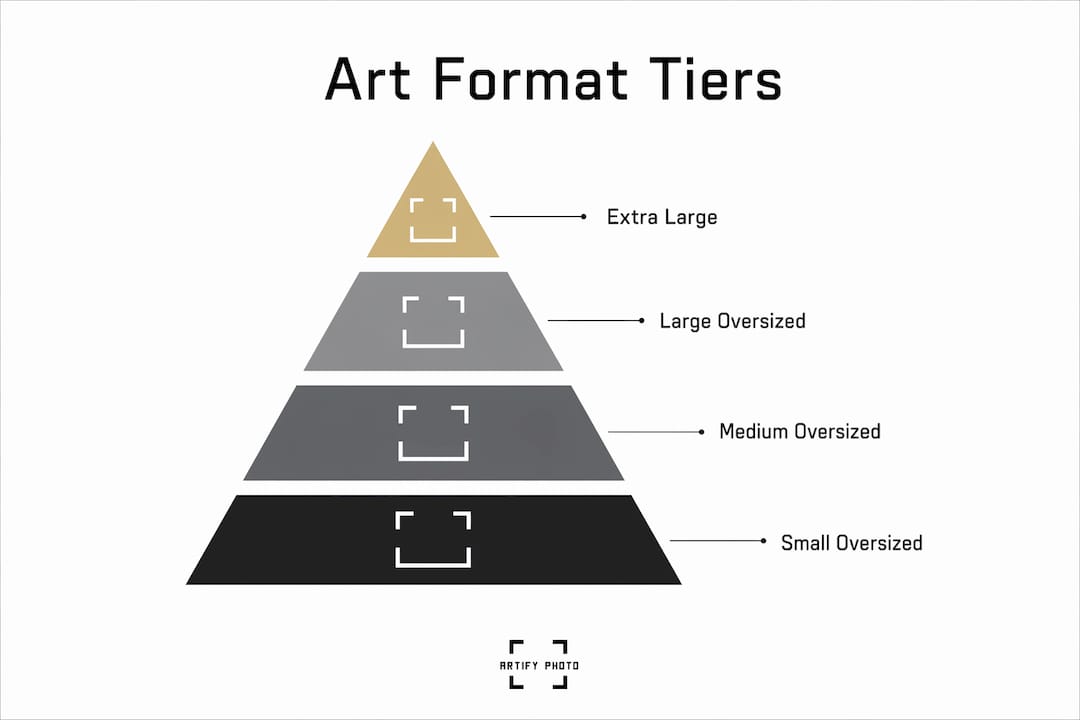
Large format art is classified by physical dimension thresholds that determine how a piece is produced, framed, and displayed. The four oversized tiers are:
| Tier | Dimensions |
|---|---|
| Small Oversized | 40x60 inches and above |
| Medium Oversized | Up to 80 inches on the longest side |
| Large Oversized | 81 to 99 inches |
| Extra Large | 100 inches and beyond |
These thresholds are not arbitrary. Each tier introduces new structural and logistical demands. A piece crossing the 40x60 threshold can no longer rely on standard off-the-shelf framing. Beyond 80 inches, the substrate itself must be engineered to resist flex and torque. This means the classification system directly drives production decisions, from the type of canvas or aluminum substrate chosen to the wall-mounting hardware specified.
Pro Tip: When planning a large format piece, decide on the final display tier before you begin production. The framing and mounting system you will need at 90 inches is fundamentally different from what works at 50 inches, and retrofitting is expensive.
What makes art large format is not just the number on a tape measure. The Paul Kyle Gallery defines the concept of intended scale in painting as the relationship between a work’s physical size and the viewer’s body, where scale transforms art from an object into an environment experienced bodily. A 48x72 inch painting hung in a cathedral ceiling loft reads differently than the same piece in a compact apartment hallway. Intended scale accounts for both the absolute dimensions and the architectural context in which the work will live.
What artistic and experiential effects does large format art create?
Large format art shifts the viewer’s role from passive observer to spatial participant. This is the core experiential distinction between a standard print and a large scale work. When a photograph or painting reaches 150 to 180 centimeters and beyond, it stops being something you look at and becomes something you stand inside. Thomas Crauwels describes large format photography as a spatial organizing element, a visual center of gravity that affects room proportion the way a structural column does.
Several specific effects distinguish large scale art from smaller work:
- Air and negative space. In large format portraits, the empty space surrounding a subject stops functioning as a margin and becomes intentional visual territory. Yago Partal’s XXL animal portraits demonstrate this clearly: the empty space around subjects at scale forces the viewer to move laterally, discovering the image rather than consuming it in a single glance.
- Texture visibility. Brushwork, grain, and surface detail invisible at small sizes become legible and tactile at large scale. A viewer standing two feet from a 72-inch canvas can read individual paint strokes the way you read type on a page.
- Emotional weight. Scale amplifies the emotional register of a subject. A portrait at 20x24 inches is intimate. The same composition at 60x80 inches is confrontational, commanding, and impossible to ignore.
- Spatial gravity. Large format pieces humanize and structure open architectural spaces, adding personality and visual balance to rooms that would otherwise feel undefined.
“Scale transforms art from an object to an environment experienced bodily.” — Paul Kyle Gallery
Homes with well-proportioned large scale art can see a 20% increase in perceived property value. That figure reflects something real: large format art signals intention, investment, and spatial intelligence in a way that a grid of small prints simply cannot replicate.
What technical challenges come with producing large format art?
Producing large format art is an engineering problem as much as a creative one. The technical demands increase non-linearly as dimensions grow, and artists who underestimate this pay for it in warped substrates, color-shifted prints, and pieces that cannot safely hang on a wall.
Here are the core technical considerations in order of priority:
- File resolution and construction. Digital files for large format must be built for scale from the start. A file not constructed at the correct resolution and color profile will not enlarge cleanly. For wide-format inkjet printing, files are typically prepared at 150 to 300 DPI at final output size, with color management profiles matched to the specific printer and substrate combination.
- Substrate selection. Canvas, fine art paper, aluminum Dibond, and acrylic face-mount are the four primary substrates for large format work. Each behaves differently under humidity, temperature change, and physical stress. Aluminum Dibond is the most dimensionally stable option for Extra Large tier pieces, resisting the flex and torque that destroy stretched canvas at 90+ inches.
- Framing and mounting engineering. Standard framing is unreliable beyond 40x60 inches. Oversized framing requires reinforced substrates, rigid joinery, and weight distribution systems that account for the piece’s mass across multiple wall anchor points. Framing at this scale is a structural calculation, not an aesthetic one.
- Humidity and climate management. Oversized framing must account for flex, torque, and humidity variation. Paper and canvas substrates expand and contract with ambient moisture. In climates with significant seasonal humidity swings, this movement can crack gesso, delaminate face-mounts, and split frame joints over time.
- Storage and handling. Large format pieces require dedicated storage space, protective interleaving, and at least two people for safe handling. Rolling a canvas for transport is possible up to certain dimensions, but rigid substrates must be crated and stored flat or vertically with full-edge support.
Pro Tip: Before committing to a substrate for a large format piece, request a test print at 24x36 inches on your chosen material. Color, texture, and surface finish all read differently at scale than they do on a small sample swatch.
Artify’s sizes and framing resource covers these decisions in practical detail for buyers navigating large format options for the first time.
How do artists and photographers approach large format creation?
The creative process for large format art requires rethinking compositional habits built around smaller work. Artists who simply scale up a composition designed for a 16x20 inch canvas typically produce work that feels empty, unresolved, or visually thin. Large scale art demands a fundamentally different approach to composition, detail, and narrative.
Key creative considerations include:
- Compositional planning for air. Successful large format composition plans for intentional surrounding space and secondary visual layers that only reveal themselves at scale. A subject placed dead-center in a large format piece often reads as static. Deliberate negative space creates movement and draws the viewer’s eye through the image over time.
- Detail as a reward for proximity. Large scale work should contain layers of detail that reward a viewer who moves close. Yago Partal’s large format animal portraits embed fine fur texture and subtle color gradients that are invisible from across the room but become the primary experience at arm’s length. This layering is a technique, not an accident.
- Medium and surface choices. The surface a large format piece is printed or painted on directly affects its experiential quality. Matte fine art paper absorbs light and creates depth. Acrylic face-mount reflects ambient light and produces luminosity. Stretched canvas adds physical texture that interacts with raking light in ways flat substrates cannot.
- Scale as narrative. The decision to work at large scale is itself a statement about the subject’s importance. Portrait photographers who print at 60x80 inches are asserting that the subject commands that much space and attention. This is a curatorial and editorial decision as much as a technical one.
- Orientation and proportion. The choice between portrait and landscape orientation at large scale has significant spatial consequences. A portrait vs. landscape decision at 80 inches affects ceiling height perception, wall width, and the viewer’s physical relationship to the piece in ways that smaller formats never force you to consider.
Technical mastery in proportion and color is the key to balancing boldness with harmony in large format art. Getting the scale right means the piece feels inevitable in its space. Getting it wrong means a technically impressive print that fights its environment rather than completing it.
Large format art also requires dedicated wall space and deliberate placement to preserve its intended effects. A piece designed to function as a room’s visual anchor loses that function entirely if hung casually on a wall that is too small, too cluttered, or at the wrong height.
Key takeaways
Large format art is defined by intended scale, not just physical size. The most effective large format work is engineered from the file level through to the wall anchor, with every decision serving the viewer’s spatial experience.
| Point | Details |
|---|---|
| Scale starts at 40x60 inches | Four classification tiers determine framing, substrate, and mounting requirements. |
| Intended scale drives impact | Size relative to the viewer’s body and the room matters more than absolute dimensions. |
| File preparation is non-negotiable | Digital files must be built at correct resolution and color profile before any production begins. |
| Framing is structural engineering | Standard framing fails beyond 40x60 inches; reinforced systems and weight distribution are required. |
| Placement preserves the work’s effect | Large format art loses its spatial impact without dedicated wall space and deliberate positioning. |
Scale is a decision, not a default
At Artify, we have seen the same pattern repeat across hundreds of large format pieces. The artists and collectors who get it right treat scale as the first creative decision, not the last. They do not start with a composition and then ask how big it should be. They start with the wall, the room, and the viewer’s body, and they work backward to the image.
The most common misconception we encounter is that large format art is simply a bigger version of a standard print. It is not. A piece designed for 20x24 inches, scaled to 60x80 inches, will almost always feel wrong. The composition will feel empty, the subject will feel adrift, and the detail that made the smaller version compelling will be invisible at the distances from which a large format piece is typically viewed.
What we find genuinely underappreciated is the role of negative space at scale. The empty areas in a large format piece are not wasted real estate. They are the breathing room that makes the subject feel significant. Collectors who understand this choose pieces that feel almost sparse at first glance and then discover, over weeks of living with the work, that the space around the subject is doing as much work as the subject itself.
For creators, the practical takeaway is straightforward: build your file for the final output size from day one, choose your substrate before you finalize your composition, and treat the framing and mounting system as part of the artwork rather than an afterthought.
— Artify
Bring large format art into your space with Artify
Artify makes large scale art accessible whether you are a collector looking for a statement piece or a photographer ready to see your own work at its full potential.
Artify’s pre-made collections include curated large format photography and fine art prints across a range of styles, from architectural minimalism to bold portraiture. Every piece is produced on gallery-quality substrates with framing options engineered for oversized dimensions. If you want to create something personal, Artify’s custom art creation process guides you from file upload through substrate and size selection to final delivery. Use Artify’s size guide to match your wall dimensions to the right format tier before you commit.
FAQ
What is large format art?
Large format art refers to artworks created at dimensions significantly larger than standard sizes, typically starting at 40x60 inches, designed to create an immersive spatial experience rather than simply decorate a wall.
What makes art qualify as large format?
Art qualifies as large format based on both its physical dimensions and its intended scale. Works above 40x60 inches enter the oversized category, with four tiers extending to 100+ inches, each requiring specialized framing and mounting.
What are examples of large format art techniques?
Large format art techniques include wide-format inkjet printing on canvas or aluminum Dibond, acrylic face-mounting, large scale oil and acrylic painting on reinforced stretcher bars, and digital photography printed at 150 centimeters and above.
How do I prepare a digital file for large format printing?
Digital files for large format printing must be built at the correct resolution (typically 150 to 300 DPI at final output size) with color management profiles matched to the printer and substrate, as files not constructed for scale will not enlarge cleanly.
Does large format art work in smaller rooms?
Large format art can work in smaller rooms when the piece is correctly proportioned to the wall and the viewer’s distance from it. Intended scale matters more than absolute room size, and a single well-chosen large format piece often defines a compact space more effectively than multiple smaller works.