Art is valuable because it does something no other human activity can replicate: it simultaneously preserves who we were, shapes who we are, and opens up who we might become. That claim holds across every dimension you can measure it by, from neuroscience to philosophy to economics. The National Endowment for the Arts puts it plainly: the arts matter because they help us understand how we matter. Here is what that actually looks like across the full range of art’s value:
- Cultural preservation: Art records civilizations, transmits history, and anchors collective identity across generations.
- Emotional expression and therapy: Creative engagement regulates emotion, reduces depression and anxiety, and supports recovery from trauma and illness.
- Social cohesion: Shared art experiences build community, reduce intolerance, and create belonging.
- Empathy cultivation: Engaging with art trains people to take on other perspectives, a capacity that transfers to real social behavior.
- Philosophical meaning: Art’s intrinsic value, its refusal to be purely useful, is precisely what makes it a space for authentic reflection and self-transformation.
Research synthesized by the World Health Organization across over 3,000 studies confirms a major role for the arts in health prevention, promotion, and management across all ages. That is not a soft claim about creativity being nice to have. It is a finding from one of the largest evidence reviews ever conducted on the subject.
How art shapes culture and society
Art is the most durable record humanity has ever produced. Cave paintings in Lascaux predate writing by tens of thousands of years, and they still communicate something legible about the people who made them. That capacity to carry meaning across time is why the American Academy of Arts and Sciences describes an education without the arts as “an impoverished education leading to an impoverished society.”

The cultural significance of art goes well beyond museums. Art shapes the values and beliefs a community holds, often before those values are ever articulated in policy or law. Think of the role music played in the Civil Rights Movement, or the way plays like Angels in America shifted public understanding of AIDS. Art does not just reflect culture; it actively constructs it.
The National Endowment for the Arts emphasizes art’s role in fostering empathy, understanding history, and building community identity, treating these not as side effects but as core functions. Arts education specifically builds the kind of civic capacity that democracies depend on: critical thinking, tolerance, the ability to hold multiple perspectives at once.
- Historical continuity: Art transmits knowledge and values that written records alone cannot capture.
- Economic contribution: The arts sector generates employment, tourism, and creative industry revenue, though art’s economic value is never reducible to those numbers alone.
- Education: Arts education builds cognitive skills, communication, and resilience that transfer across every career path.
- Community formation: Public art, local theater, and community murals give neighborhoods a shared identity and a reason to gather.
The economic dimension of art deserves a brief note. Collecting original works has historically served as a store of value, and the art market in the United States generates billions annually. But treating art purely as an investment misses the point. A painting’s monetary value at auction tells you almost nothing about its artistic value, a distinction philosophers of art have been making for centuries.
Art’s emotional and therapeutic power is backed by neuroscience
The therapeutic case for art is no longer speculative. A march 2026 review identified at least 50 distinct causal mechanisms through which arts engagement improves mental health, spanning neuroscience, psychophysiology, and social science. That number is striking because it rules out the idea that art’s benefits are a single effect with a single explanation.
At the neurological level, both active creation and passive viewing consistently activate the medial prefrontal cortex and the amygdala, the brain regions most directly involved in emotional regulation. A systematic review of neural mechanisms found that creative arts engagement activates the same circuits as effective emotional regulation strategies, suggesting the two processes share underlying neural pathways. Art therapy, in particular, works by reconfiguring the brain’s default mode network (DMN), the salience network, and the central executive network, shifting the brain from rigid, maladaptive states toward more flexible ones.
Statistic callout: Randomized controlled trials show that art therapy significantly reduces depression in post-stroke patients and alleviates pain, nausea, and anxiety in breast cancer survivors.
The clinical applications extend well beyond those two populations. Art therapy shows benefits in trauma, schizophrenia, neurodegenerative diseases, and cancer-related symptoms. The American Art Therapy Association, formally established in 1969, has spent decades building the clinical infrastructure to deliver these interventions. The neuro-psycho-cultural framework now used to explain art therapy’s effects integrates biological, psychological, and cultural dimensions, which is why it works across populations that differ dramatically in background and diagnosis.
- Emotion regulation: Art making and viewing activate neural circuits that reduce emotional reactivity and build resilience.
- Self-identity: The creative process helps people reconstruct fragmented self-narratives, particularly after trauma or illness.
- Flow states: Deep engagement with art produces psychological flow, a state associated with reduced anxiety and heightened well-being.
- Daily health markers: Regular creative activity has been shown to improve cortisol patterns and autonomic balance.
The mental health benefits of art extend into everyday home environments, not just clinical settings. Living with art you find meaningful is not a luxury; it is a low-cost, continuous form of aesthetic engagement that keeps those neural circuits active.
Pro Tip: You do not need to be in therapy to access art’s emotional benefits. Spending 15 minutes genuinely looking at one piece, rather than scrolling past dozens, activates the kind of deep engagement that produces real psychological effects.
Art creates genuine human connection
Art builds connection in a way that is hard to engineer through any other means. As Maryrose Flanigan of the National Endowment for the Arts describes it, art provides “a mutual space where we can talk to one another about the most important things” and can turn strangers into old friends. That is not a metaphor. It describes a real social mechanism.
Clinical research confirms the distinction between passive and active engagement. Shared discussion of art in museum settings increases social connectedness and well-being more than silent observation of the same works. The difference is the conversation art makes possible, the way a painting or a poem gives people a shared object to respond to, disagree about, and ultimately connect through.
Cross-cultural understanding is another concrete outcome. Aesthetic experiences promote empathy, social connection, and cross-cultural understanding, according to research in neuroaesthetics summarized by the American Psychological Association. When you engage seriously with art from a culture different from your own, you are not just learning facts about that culture. You are practicing the cognitive and emotional skill of inhabiting another perspective.
- Shared experience: Arts events are among the most effective ways to gather people around a common focus.
- Cross-cultural dialogue: Engaging with art from other traditions builds genuine understanding, not just tolerance.
- Community identity: Public and community arts projects give groups a shared creative history and a sense of collective authorship.
- Interpersonal neural synchrony: Art therapy in group settings promotes neural synchrony between participants, deepening relational bonds at a biological level.
The role of art in personalization within shared spaces reflects this social function directly. When a household or community chooses art together, the selection process itself becomes a form of connection.
The philosophical case for art’s value
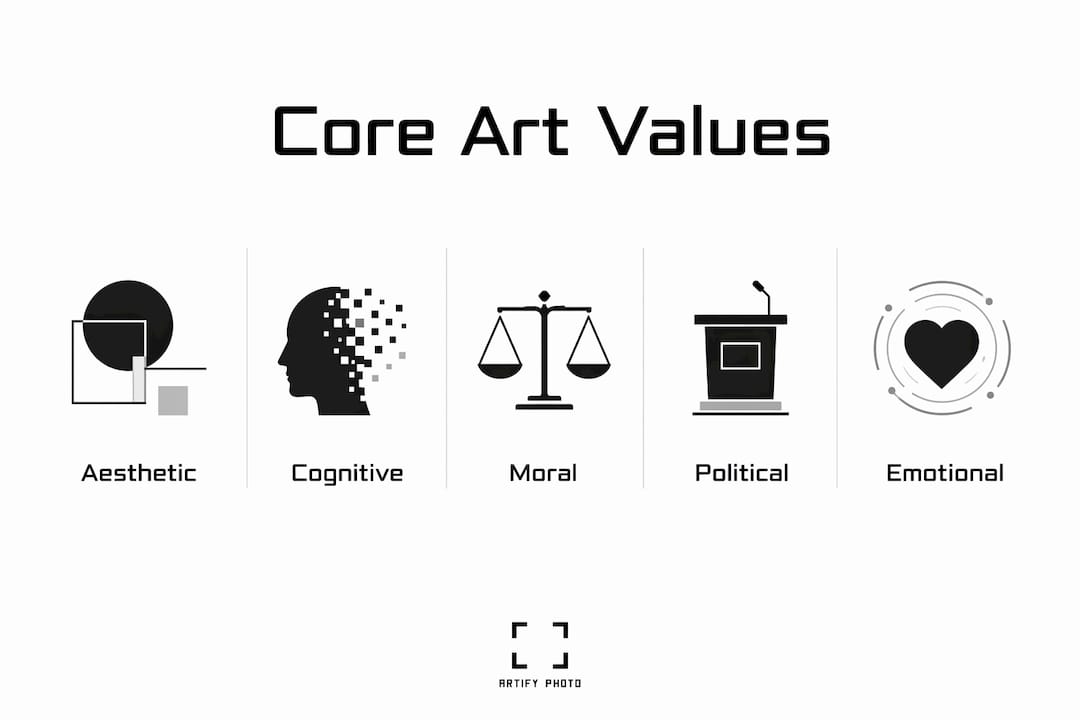
Philosophers have argued about art’s value for centuries, and the most interesting contemporary position is also the most counterintuitive: art’s value is composite. It is not reducible to a single property like beauty, moral instruction, or cognitive gain. As contemporary aesthetician Louise Hanson argues, artistic value is attributive goodness, meaning it is comprised of intersecting moral, political, cognitive, and aesthetic dimensions, all of which contribute to how good something is as art.
That composite nature is why great art tends to prompt viewers to reimagine reality rather than simply confirm what they already believe. A novel that is morally uncomfortable can have high artistic value precisely because of that discomfort. A politically charged mural can be aesthetically powerful and cognitively revelatory at the same time. These dimensions do not cancel each other out; they compound.
The deeper philosophical claim concerns art’s intrinsic purposiveness. Philosophers distinguish art from purely instrumental activities by pointing to its fundamental value as an end in itself, enabling self-transformation that no amount of profit or entertainment can replicate. You cannot reduce a great painting to what it teaches you or what it sells for. Its value as art exists in the experience of engaging with it.
- Cognitive value: Art trains propositional knowledge, experiential understanding, and empathic capacity simultaneously.
- Moral dimension: Artworks can cultivate moral awareness by exposing viewers to perspectives and situations they would never otherwise encounter.
- Political commentary: Art raises consciousness about social and political realities, recalibrating attitudes without the coercive force of argument.
- Aesthetic perception: Developing the ability to perceive beauty and meaning in art is itself a form of human flourishing.
Art’s so-called “uselessness” is actually its most philosophically significant feature. Because art resists utilitarian reduction, it creates a space where critical reflection and authentic living become possible. In a culture that constantly pushes people toward productivity and consumption, art’s refusal to be purely useful is a form of freedom.
Key Takeaways
Art is valuable because it simultaneously preserves cultural identity, regulates emotion through documented neural mechanisms, builds social connection, and provides a space for philosophical reflection that no purely utilitarian activity can replicate.
| Point | Details |
|---|---|
| Scientific evidence is extensive | Over 3,000 studies synthesized by WHO confirm art’s role in health prevention, promotion, and management across all ages. |
| Neural mechanisms are measurable | At least 50 distinct causal mechanisms explain how arts engagement improves mental health, spanning neuroscience, psychophysiology, and social science. |
| Clinical benefits are documented | Randomized controlled trials show art therapy reduces depression in post-stroke patients and alleviates pain and anxiety in cancer survivors. |
| Active engagement amplifies social value | Shared discussion of art increases social connectedness more than passive observation of the same works. |
| Philosophical value is composite | Artistic value intersects moral, cognitive, aesthetic, and political dimensions, making art irreducible to any single measure. |
FAQ
Why do we value art?
Art satisfies needs that nothing else addresses as directly: the need to express complex emotion, to connect with others across cultural distance, and to make sense of experiences that resist plain language. The National Endowment for the Arts frames it as art helping us understand how we matter.
How does art become so valuable?
Artistic value is composite, built from intersecting aesthetic, cognitive, moral, and political dimensions rather than any single property. Monetary value at auction often correlates with artistic value, but the two are distinct: a work can have high artistic value without commanding high prices, and vice versa.
What are the core values of art?
Philosophers identify at least four overlapping dimensions: aesthetic value (sensory and formal qualities), cognitive value (what art teaches or reveals), moral value (how it shapes ethical awareness), and political value (how it raises consciousness about social realities). These compound rather than compete.
Why is art important in daily life?
Regular engagement with art, including living with meaningful pieces at home, activates neural circuits linked to emotional regulation and well-being. Research shows daily creative activity improves cortisol patterns and autonomic balance, effects that accumulate over time without requiring formal therapy.
Art is not a luxury you add to life once everything else is settled. It is one of the mechanisms by which life becomes worth settling into. If you want to bring that into your own space, Artify’s pre-made collections offer gallery-quality work from independent artists, ready to put on your wall.